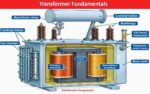
Transformers Fundamentals: Transformers are static devices that transfer electrical energy from one circuit to
another by the phenomenon of electromagnetic induction without any change in frequency.
Join EEE Made Easy Whatsapp Channel
Transformers Fundamentals
Transformers can link circuits that have different voltages, which is one of the enabling factors for the universal use of the alternating current (AC) system for the transmission and distribution of electrical energy.
Hence, transformers ensure that various components of the power system, viz. generators, transmission lines, distribution networks and loads, can all be operated at their most suitable voltage levels.
As transmission voltages are increased to higher levels in some parts of a power system, transformers again play a key role in interconnecting the different parts of the system at different voltage levels.
Transformers are therefore vital links between the generating stations and the points of utilization in any system.
The transformer is an electromagnetic conversion device in which the electrical energy received by its primary winding is first converted into magnetic energy, which is re-converted into electrical energy in other circuits (secondary winding, tertiary winding, etc.).

Thus, the primary and secondary windings are not connected electrically, but coupled magnetically.
A transformer is termed either a step-up or a step-down transformer depending upon whether the
secondary voltage is higher or lower than the primary voltage.
Transformers can be used to either step-up or step-down voltage depending upon the need and
application; hence, their windings are referred as high-voltage/low-voltage or high-tension/low-tension windings instead of primary/secondary windings.
Magnetic circuits
A transfer of electrical energy between two circuits takes place through a transformer without the use of moving parts; a transformer therefore has higher efficiency and lower maintenance cost than rotating
electrical machines.
Better grades of materials for cores are continuously being developed and introduced.
Different types of silicon steels have been introduced in the following chronological order:
- non-oriented
- hot-rolled grain oriented
- cold-rolled grain oriented (CRGO)
- Hi-B
- mechanically scribed and laser scribed.
The last three types are improved versions of the CRGO class of materials.
The saturation flux density has remained more or less constant around 2.0 Tesla for the CRGO grades; however, the sophisticated technologies and processes used while manufacturing the better grades have resulted in significant improvements in the watts/kg and volt-amperes/kg characteristics in the rolling
direction.
Transformer designers have a limited choice of grades of material; for a grade chosen based on a cost-benefit analysis, the performance of the core can be further optimized by using efficient design and manufacturing technology.
The non-mitred construction used earlier was replaced by a better mitred type many decades ago, and now a far superior step-lap construction is almost universally used.
A considerable increase in energy costs over the years is mainly responsible for the development (and consequent increase in the use) of the better grades of material for cores: these not only reduce the core loss but also help in reducing the noise levels of transformers.
The use of amorphous steel materials results in a substantial reduction in the core loss, to the tune of
60-70% when compared to the CRGO grades.
Since the manufacturing technology required for handling this brittle material has to be quite
sophisticated, its use is limited to transformers with lower ratings.
Windings: Paper-covered conductors are commonly used in the windings of medium and large power transformers.
These conductors can be of individualstrip, bunch or continuously transposed cable (CTC) type. For the low voltage side of distribution transformers, wherein far fewer turns are involved, the use of copper or aluminum foils may be preferred.
To enhance the short-circuit withstand capability, a work-hardened copper material is commonly used
instead of a soft annealed type, particularly for higher-rating transformers.
In generator transformers with high current ratings on the lower voltage (LV) side, CTC conductors are mostly used, which result in a better space factor and reduced eddy loss in windings.
CTC conductors can be of the epoxy-bonded type to enhance their short-circuit strength.
Conductors with thermally upgraded insulating paper are suitable for hot-spot temperatures of about 110C, which help in coping with overload conditions.
Moreover, a better life expectancy is possible with their use.
For better mechanical properties, epoxy diamond dotted paper can be used as the interlayer insulation for multi-layer windings.
High temperature superconductors are expected to be available commercially in the near future. Issues such as economic viability, manufacturability, and reliability need to be addressed prior to their large-scale deployment.
Insulation and cooling: Inter-winding insulation structures consist of a number of oil ducts formed by suitably spaced insulating cylinders. Pre-compressed pressboards, manufactured using high quality materials and processes, are used in high voltage transformers.
Well-profiled angle rings, angle caps, and other special insulation components are also widely used.
Mineral oil has traditionally been the most commonly used electrical insulating medium and coolant in transformers.
Studies have proved that the oilbarrier insulation system is suitable even at voltages rated higher than 1000 kV.
The high dielectric strength of oil-impregnated papers and pressboards is the main reason for the widespread use of mineral oil in transformers.
Silicone oil is an alternative; it is non-toxic and fire-resistant. A comparatively higher cost is an
inhibiting factor in its widespread use.
Transformers with biodegradable natural and synthetic esters are employed in environmentally sensitive locations.
There have been considerable advancements in the technology of gas immersed transformers.
SF6 is a non-flammable gas and has excellent dielectric properties. Hence, SF6 transformers are preferred for fire-hazard-free applications.
Due to the low specific gravity of SF6 gas, gas-insulated transformers are lighter than oil-immersed transformers.
The dielectric strength of SF6 gas is a function of the operating pressure; the higher the pressure, the higher the dielectric strength is.
However, the heat capacity and thermal time constant of SF6 gas are less than those of oil, resulting in a lower overload capacity of SF6 transformers.
Environmental concerns, sealing problems, lower cooling capability, and the present high cost of manufacture are the challenges that have to be overcome for widespread use of SF6 transformers.
Dry-type resin cast and resin impregnated transformers use class F or C insulation. The high cost of resins and their lower heat dissipation capability limit the use of these materials to transformers that have lower ratings.
Dry-type transformers are primarily used for indoor applications in order to minimize fire hazards. Nomex paper insulation, which has a temperature withstand capacity of 220C, is widely used in dry-type transformers.
The initial cost of a dry-type transformer may be 60 to 70% higher than that of an oil-cooled transformer at
current prices, but its overall cost at the present level of energy rates can be quite comparable to that of the oil-cooled transformer.
Design
With the rapid development of digital computers, designers are freed from the drudgery of routine calculations.
Computers are widely used for the optimization of designs. Within a few minutes, today’s computers can work out a number of designs (by varying flux density, core diameter, current density, etc.) and come up with an optimum design.
One of the major benefits of computers is in the area of analysis. Using commercial 2-D/3-D field computation software, any kind of engineering analysis (electrostatic, electromagnetic, structural, thermal,
etc.) can be performed to optimize the design of transformers or to enhance their reliability.
Manufacturing
In manufacturing technology, the superior techniques listed below are used to reduce manufacturing time and at the same time to improve product quality:
- A high degree of automation for slitting/cutting operations to achieve better dimensional accuracy for core laminations
- Step-lap joints for core construction to achieve lower core loss and noise level.
- Core building without top yoke
- Automated winding machines for distribution transformers
- Vapor phase drying for effective and fast drying
- Low frequency heating for the drying process of distribution transformers
- Pressurized chambers to protect windings and insulating parts from pollution and dirt
- Vertical machines for winding large-capacity transformer coils
- Isostatic clamping for accurate sizing of windings
- High-frequency brazing for joints in the windings and connections.
Accessories
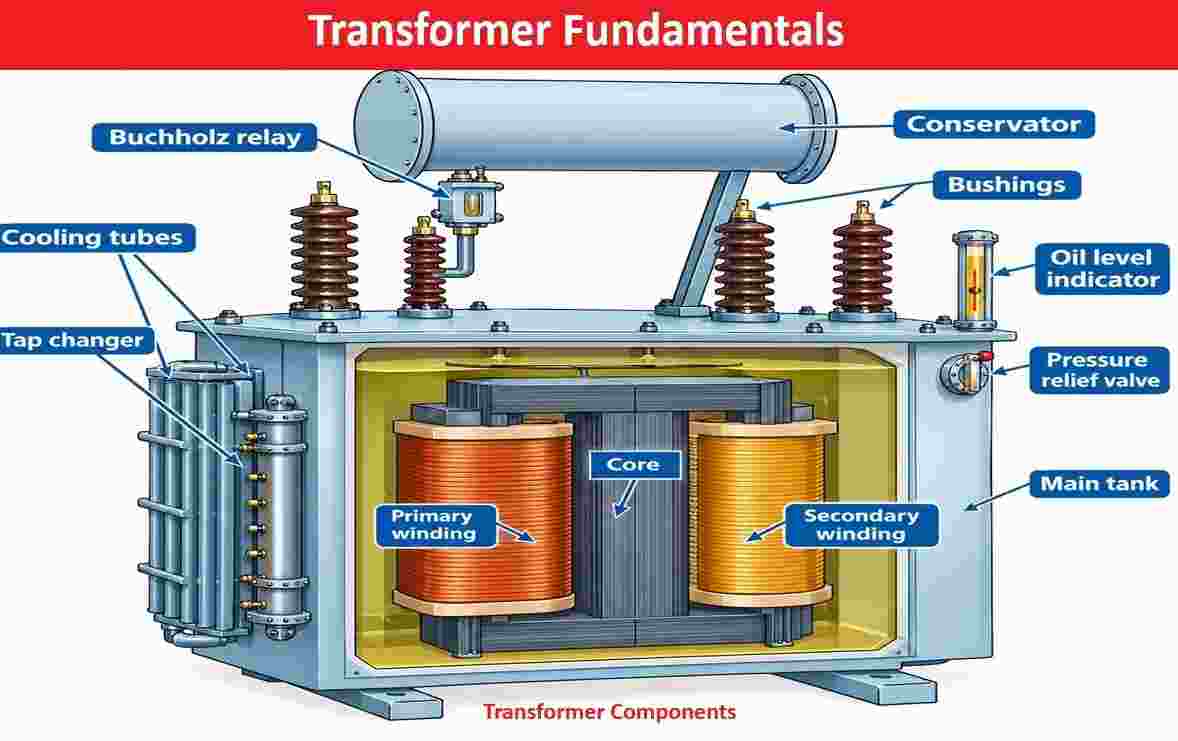
Bushings and the tap changer (off-circuit or on-load) are the most important accessories of a transformer. The technology of bushing manufacture has advanced from the oil-impregnated paper (OIP) type to the resin impregnated paper (RIP) type, both of which use porcelain insulators.
Silicone rubber bushings are also available for oil-to-air applications; due to the high elasticity and strength of silicone rubber, the strength of these bushings against mechanical stresses and shocks is higher. Oil-to-SF6 bushings are used in GIS (gas-insulated substation) applications.
The service reliability of on-load tap-changers (OLTC) is of vital importance; failures of transformers due to tap-changer problems are common.
A majority of the failures reported in service are due to mechanical problems related to the drive system. Several monitoring methods are used for enhancing the service reliability of OLTCs, which include measurement of contact resistance, monitoring of drive motor torque/current, acoustic measurements,
dissolved gas analysis, and temperature rise measurements.
Diagnostic techniques
Several offline and online diagnostic tools are available for monitoring in-service transformers to provide information about their operating conditions. Dissolved gas analysis is widely used in conjunction with
routine tests on oil and winding insulation.
Frequency response analysis is being widely used to assess the mechanical condition of windings. Recently, online partial discharge monitoring techniques based on acoustic and ultra-high frequency sensors have also been deployed.
Advanced time- and frequencydomain methods are becoming popular for the diagnostics of insulation.
However, the higher costs of the advanced instruments required for this purpose inhibit their widespread use.
An important factor that must be kept in mind is that field experience with some of the monitoring techniques is limited.
A close cooperation between manufacturers and users is necessary for developing good
monitoring and diagnostic systems for transformers.
Transformer technology is developing at a tremendous rate and computerized operations have replaced manual work in the design office.
Continuous improvements in materials and manufacturing technologies along with the use of advanced computational tools have contributed towards making transformers more efficient, compact and reliable.
Advanced diagnostic tools and several emerging trends in transformer applications are expected to fulfill a
number of existing and emerging requirements of utilities and end-users.
Join EEE Made Easy Whatsapp Channel
Read More on Transformer
- Transformers MCQ questions set 1
- Transformers MCQ Questions- Set 2
- Transformer MCQ Questions Set 3
- Efficiency of Transformer|Equation & Example
- Losses in a Transformer
- [Solved]Transformer Voltage Regulation Problem
- LVDT|Linear Variable Differential Transformer
- Autotransformer|Application of Autotransformer
- Transformers Electrical Engineering Interview Questions
- Why Transformers Hum: 7 Shocking Causes and Expert Solutions You Need to Know
- Single-phase transformer Connections Series & parallel
- Hysterisis and Eddy current losses
- Special Transformers
- Static Electrification in transformers
- Magnetostriction and its ill effects
Books for All Competitive Exams
Latest Posts in EEE Made Easy
- Transformers Fundamentals
 Transformers Fundamentals: Transformers are static devices that transfer electrical energy from one circuit toanother by the phenomenon of electromagnetic induction … Read more
 - Transformer Tank Types|Classification of Transformer TanksTransformer Tank Types: Depending upon the position of the joint between the upper and lower parts, wehave two types of … Read more
- Static Electrification in transformersStatic Electrification in transformers: Generation of static charges, caused by oil streaming on a solid insulating component, is responsible for … Read more
- Special TransformersSpecial Transformers: There are some special transformers like Rectifier Transformers,Converter Transformers for HVDC,Furnace Transformers and Phase Shifting Transformer. Special Transformers … Read more
- Magnetostriction and its ill effectsMagnetostriction and Its ill-effects:The property of ferromagnetic materials, due to which their dimensions are changed due to change of magnetic … Read more
- Losses in a TransformerLosses in a Transformer:The losses which occur in an actual transformer are: (i) Core or iron losses (ii) Copper losses … Read more
- Electrician Printing Dept Syllabus Kerala PSC|771/2025 Syllabus Kerala PSCElectrician Printing Dept Syllabus Kerala PSC : KERALA PUBLIC SERVICE COMMISSION DETAILED SYLLBUS FOR THE POST OF ELECTRICIAN GR.II IN … Read more