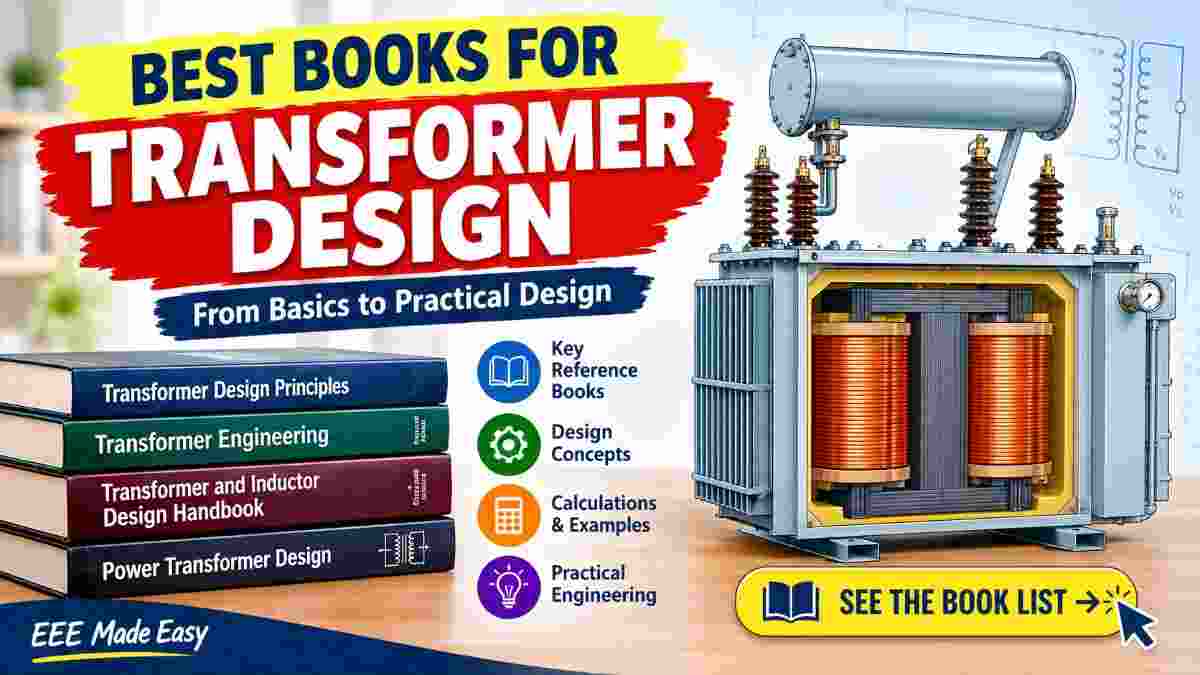
Best Books for Transformer Design and Electrical Machine Design: If you are studying Transformer Design, Electrical Machine Design or Design of Electrical Machines, choosing the right textbook can make a big difference.
Join EEE Made Easy Whatsapp Channel
Best Books for Transformer Design and Electrical Machine Design
I have always felt that machine design is one of those EEE subjects where simply memorising formulas is not enough. You need to understand why a particular equation is used, how the dimensions are selected, how electrical and magnetic loading are related, and how practical design limitations affect the final machine.
For students preparing for university examinations, GATE, engineering recruitment examinations or simply trying to strengthen their EEE fundamentals, I would suggest keeping at least one good design textbook and one detailed reference book.
Below are some books that I find particularly useful for Transformer Design and Electrical Machine Design, including several books from Indian authors and publishers.
Books for All Competitive Exams
1. Transformer Engineering: Design, Technology, and Diagnostics – S.V. Kulkarni and S.A. Khaparde
If your main interest is transformer design, this is the book I would put at the top of the list.
Authors: S.V. Kulkarni and S.A. Khaparde
Publisher: CRC Press
Edition: Second Edition
This is not just a basic transformer textbook. It goes considerably deeper into the engineering aspects of transformer design, construction and operation.
The book covers transformer fundamentals, magnetic characteristics, impedance characteristics, eddy-current and stray losses, short-circuit stresses, surge phenomena, insulation design, cooling, structural design and special transformers. It also includes electromagnetic-field computations, transformer-system modelling, monitoring and diagnostics, and a sample transformer design.
Why I would recommend it
What I particularly like about this book is that it connects theory with actual transformer engineering.
If you have already studied basic transformer theory and now want to understand what goes into designing a practical transformer, this is a much better starting point than relying only on short examination notes.
It is especially useful for:
- Transformer design
- Power transformer engineering
- Transformer losses
- Short-circuit strength
- Insulation design
- Cooling systems
- Transformer diagnostics
- Research and advanced study
The authors also have substantial academic and industry experience. S.V. Kulkarni, for example, worked in transformer design and development before joining IIT Bombay.
My suggestion: Keep this as a reference book, rather than trying to read all 750 pages from beginning to end for an ordinary university examination.
2. A Course in Electrical Machine Design – A.K. Sawhney and A. Chakrabarti
This is one of the Indian books I would definitely consider if you are studying Electrical Machine Design.
Published by Dhanpat Rai, the book covers a wide range of topics including electrical engineering materials, heating and cooling, magnetic circuit design, thermal design, transformer design, mechanical aspects of machines, DC machines, induction motors and synchronous machines.
Why I like this book
For many Indian engineering students, the terminology and approach feel familiar because it is written with the conventional electrical-machine-design syllabus in mind.
Instead of concentrating only on one machine, it gives you a broader picture of how different electrical machines are designed.
It is particularly useful when you want to study:
- Magnetic circuit design
- Transformer design
- DC machine design
- Induction motor design
- Synchronous machine design
- Heating and cooling
- Electrical machine materials
- Mechanical aspects of machine design
For students who are seeing Machine Design for the first time, this can be a useful textbook to keep beside your classroom notes.
3. THE PERFORMANCE AND DESIGN OF ALTERNATING CURRENT MACHINES – M.G. Say
M.G. Say is another name that students may come across when looking for serious references on electrical machine design.
THE PERFORMANCE AND DESIGN OF ALTERNATING CURRENT MACHINES
This type of reference is particularly useful once you move beyond simply solving examination problems and want to understand the principles behind machine dimensions, electromagnetic loading, thermal considerations and machine performance.
My suggestion
I would not recommend starting your Machine Design preparation with a very advanced reference.
First understand the basic design procedure from your university textbook. Then use a book such as M.G. Say when you want to explore the subject in greater depth.
4. Electrical Machine Design – K.G. Upadhyay
K.G. Upadhyay is another Indian reference worth considering for students looking specifically for electrical machine design material.
Books in this category can be particularly useful when your syllabus contains detailed design calculations for:
- DC machines
- Induction motors
- Synchronous machines
- Transformers
- Magnetic circuits
- Electrical loading
- Magnetic loading
- Heating and cooling
A practical way to use the book
Don’t try to memorise every formula.
Instead, concentrate on understanding the sequence of a design calculation:
Specifications → main dimensions → magnetic loading → electric loading → winding → losses → heating → performance
Once this sequence becomes clear, many machine-design problems become much easier to approach.
5. Design of Electrical Machines – V. Rajini , V. S. Nagarajan
This is another useful reference for students who want to go deeper into the design of electrical machines.
I would consider this type of book particularly useful when you already know the fundamentals and want additional solved problems and design-oriented explanations.
For competitive-exam students, however, I would suggest using it selectively rather than trying to cover the entire book.
Machine Design Books: Don’t Ignore the Mechanical Side
One thing I would strongly suggest to EEE students is not to treat electrical machine design as purely an electrical subject.
A real motor or transformer has mechanical constraints too.
Shaft dimensions, bearings, mechanical stresses, vibration, cooling arrangements, materials and construction all influence the final machine.
That is why having a basic Mechanical Engineering / Machine Design reference can also be useful.
6. A Textbook of Machine Design – R.S. Khurmi and J.K. Gupta
This is one of the most familiar machine-design books among Indian engineering students.
It is primarily a mechanical machine-design textbook rather than an electrical-machine-design book.
But that does not mean it is irrelevant to an EEE student.
When you study electrical machines, you encounter mechanical components such as:
- Shafts
- Bearings
- Couplings
- Keys
- Fasteners
- Gears
- Mechanical stresses
- Rotating components
A basic understanding of these areas helps you appreciate why an electrical machine cannot be designed by considering only its electromagnetic performance.
My suggestion
You don’t need this book for every Electrical Machine Design problem.
Keep it as a supporting reference when you want to understand the mechanical side of machine construction.
7. Design Of Machine Elements – V.B. Bhandari
V.B. Bhandari is another widely used Indian author in the field of mechanical design.
For an electrical engineering student, I would use this kind of book mainly for understanding the mechanical design concepts that appear around rotating electrical machines.
It can be particularly useful if you are interested in:
- Motor construction
- Shafts
- Bearings
- Mechanical stresses
- Power transmission
- Machine components
This becomes more valuable when you move from textbook calculations toward understanding how an actual machine is physically built.
Which Book Should You Start With?
This is probably the question most students actually want answered.
I would divide the books into three groups.
If you are studying Electrical Machine Design for an exam
Start with a textbook such as:
A.K. Sawhney & A. Chakrabarti – A Course in Electrical Machine Design
Build your fundamentals first and practise the design calculations prescribed in your syllabus.
If your main interest is Transformer Design
I would move towards:
S.V. Kulkarni & S.A. Khaparde – Transformer Engineering: Design, Technology, and Diagnostics
This is a much more detailed reference and covers transformer engineering well beyond basic classroom theory.
If you want to understand the mechanical side
Keep an Indian machine-design textbook such as:
R.S. Khurmi & J.K. Gupta – A Textbook of Machine Design
or
V.B. Bhandari – Machine Design as a supporting reference.
My Suggested Combination for EEE Students
Instead of buying a large number of books, I would personally prefer having a small collection of books that complement one another.
One Important Tip for Students
Machine Design can initially look like a huge collection of formulas.
I would strongly recommend not studying it that way.
Whenever you solve a design problem, ask yourself:
What am I trying to determine?
Then ask:
What physical limitation determines that value?
For example, a machine’s dimensions are not selected randomly. They are influenced by factors such as magnetic loading, electric loading, temperature rise, insulation, mechanical strength, available materials and the required performance.
Once you start seeing the subject this way, Machine Design becomes much more logical.
Final Thoughts
For me, the most useful way to study electrical machine design is to use one accessible Indian textbook for learning and problem solving, together with one detailed reference book for deeper understanding.
For transformer engineering in particular, S.V. Kulkarni and S.A. Khaparde’s Transformer Engineering: Design, Technology, and Diagnostics stands out as a detailed reference because it goes from transformer fundamentals into practical design issues, losses, insulation, cooling, short-circuit strength, electromagnetic computation and diagnostics.
You don’t need to read every book on this list.
Choose the book that matches what you are studying right now, work through the important design calculations, and keep the more advanced references for the topics where you want to go deeper.
That approach has always made more sense to me than collecting ten books and finishing none of them.
Join EEE Made Easy Whatsapp Channel
Read More on Transformer
- Transformers MCQ questions set 1
- Transformers MCQ Questions- Set 2
- Transformer MCQ Questions Set 3
- Efficiency of Transformer|Equation & Example
- Losses in a Transformer
- [Solved]Transformer Voltage Regulation Problem
- LVDT|Linear Variable Differential Transformer
- Autotransformer|Application of Autotransformer
- Transformers Electrical Engineering Interview Questions
- Why Transformers Hum: 7 Shocking Causes and Expert Solutions You Need to Know
- Single-phase transformer Connections Series & parallel
- Hysterisis and Eddy current losses
- Special Transformers
- Static Electrification in transformers
- Magnetostriction and its ill effects