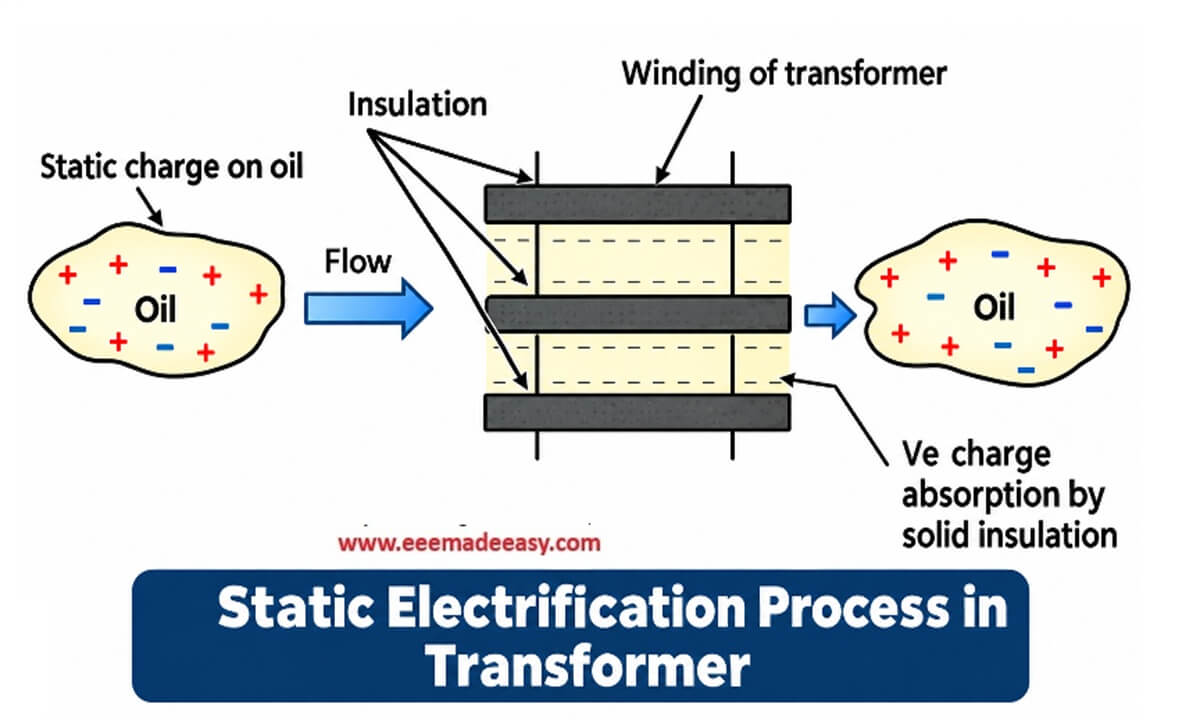
Static Electrification Phenomenon: Generation of static charges, caused by oil streaming on a solid insulating component, is responsible for streaming or static electrification phenomenon in transformers.
Static Electrification in transformers
This phenomenon occurs due to the friction between the oil and solid dielectric components of the transformers.
Depending on the type of oil and its velocity, high levels of localized electrostatic charges (due to charge separation) can be generated leading to very high voltages inside the transformer.
Such an overvoltage, depending on where it occurs inside the transformer, could trigger a sequence of electrical discharges and arcing.
Failures in some of the large high voltage transformers and autotransformers have been attributed to the occurrence of electrostatic charges.
Join EEE Made Easy Whatsapp Channel
When the voltage and power ratings of the transformer increase, tendency is to use high oil flow rates for the cooling purpose and to improve the insulation resistance.
From the standpoint of static electrification, these improvements result in an increase of charging tendency.
The accumulation of charges leads to production of a strong DC field, which may stress the insulation to an unacceptable level.
If high voltage transformers are manufactured with reduced dimensions and kg/MVA values, chances of electrostatic charging are higher.
The reduction in the weight to- power ratio usually results in greater oil velocities and more labyrinths aiding the static electrification phenomenon.
When oil flows through insulation ducts, charge separation occurs at the interface of the solid insulation and the oil.
The charge separation also occurs in the other regions of the flow system such as radiator pipes and pumps.
It has been observed that paper/pressboard insulation structure acquires a negative charge and the oil carries a positive charge.
The lower part of the insulation arrangement (i.e., bottom end insulation) may accumulate a high negative charge leading to development of an excessive DC voltage .
As the oil flows up through the windings, it becomes more and more positively charged,
and the upper tank may act as a reservoir for the positive charge.
There is charge relaxation in every part of the flow system which mitigates the effect.
The static charge distribution in the system is determined by the balance of the charge separation and charge relaxation processes .
The radiator pipes are efficient charge dissipating devices.
factors influencing static electrification
There are many factors which influence the static electrification phenomenon:
Moisture content: Moisture has a significant effect on the charging tendency; drying out causes the charge density to increase, while addition of moisture reduces it.
Since transformers are operated with low moisture levels in oil (below 10 ppm at the time of new oil filling), high charging tendencies may be experienced .
Temperature: There is an increase in charging tendency with temperature since the dryness of oil increases. Hence, it may be advisable to reduce the flow rate during the warming-up process.
Flow rate: The charging tendency increases with greater flow rates. The increase varies somewhere between the second and fourth power of the oil flow velocity.
The average flow rate involved in one of the failures was 20 cm/s over an average typical cross section ; the flow rate in the windings was 45 to 60 cm/s, and in the pumps and piping in the heat exchangers it was more than 4.5 m/s.
The consideration of static electrification decides the upper limit of the oil flow rate in forced oil cooled transformers, and thus impacts the cooling system design.
Turbulence: The charge motion or generation depends on turbulence in oil.
Surface condition: The charge generation/separation process is enhanced with increasing roughness of the solid insulation.
Pumps: Pumps can be substantial sources of charge generation .
Orifices: Orifice effects have been demonstrated to generate charges.
Fields: The AC and DC fields have definite impact on the static electrification.
Some of the methods reported for reducing charging tendency are clay filtration of oil and the addition of charge suppressors to oil .
Charge reduction by addition of charge suppressers is not a viable solution as it increases the electrical conductivity of oil.
The oil flow can be reduced in the susceptible temperature range by operating the cooling system using automatic control.
In addition to incorporating pumps that operate at low flow velocities, the effect of changing the location of pumps may also be a consideration if the pumps prove to be the prime sources of charge generation.
The pumps can be mounted at the top of radiators to allow more distance for charge relaxation in the oil prior to entering the bottom of the transformer.
Books for All Competitive Exams
Join EEE Made Easy Telegram channel
Read More on Transformer
- Transformers MCQ questions set 1
- Transformers MCQ Questions- Set 2
- Transformer MCQ Questions Set 3
- Efficiency of Transformer|Equation & Example
- Losses in a Transformer
- [Solved]Transformer Voltage Regulation Problem
- LVDT|Linear Variable Differential Transformer
- Autotransformer|Application of Autotransformer
- Transformers Electrical Engineering Interview Questions
- Why Transformers Hum: 7 Shocking Causes and Expert Solutions You Need to Know
- Single-phase transformer Connections Series & parallel
- Hysterisis and Eddy current losses
Download EEE Made Easy Ebook PDF Free