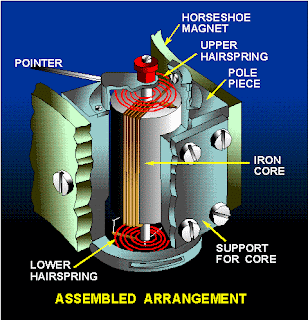
(1) Permanent Magnet Moving Coil (PMMC) instruments.
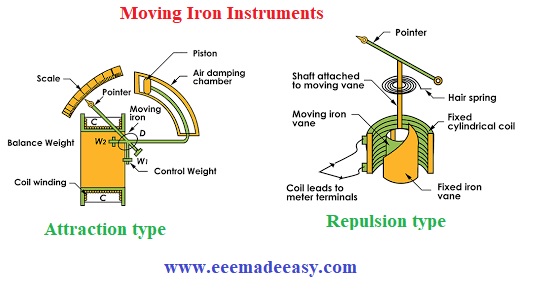
(2) Moving iron instruments.
(3) Electrodynamometer instruments.
(4) Thermal instruments
(5) Induction instruments.
(6) Electrostatic type instruments.
(7) Rectifier type instruments.
Download & Install EEE Made Easy App
Types of instruments
The PMMC instruments can be used for direct measurement only, and the induction type for alternating current measurements only.
The moving iron(MI) and moving coil(MC) types both depend for their action upon the magnetic effect of current.
The MI instruments can be used for either direct or alternating current measurements, and is the cheapest.
Electrodynamometer type of instruments can be used both on a.c as well as on d.c.
They are useful as “transfer instruments”, as their calibration for both d.c and a.c is the same.
The calibration for d.c and a.c is the same for the thermal instruments also. They are particularly suited for a.c measurements.
This is because the deflection of the thermal instruments depends directly upon the heating effect of the alternating current. ie, upon the rms value of the current.
For the electrostatic instruments, the electrostatic principle is only directly applicable to voltage measurements.
They have the advantage that, their power consumption is extremely small.
The induction principle is more generally used for Watt- hour meters than for ammeters and voltmeters.
- [PDF]Electrical Measurements Measuring Instruments Study Notes PDF|EMMI Notes EEE Made Easy
- MCQ on Electrical Instruments
- Types of Errors in Instruments| Instrument Errors
- MCQ’s on Electrical Measuring Instruments|Instruments Objective Questions
- Electrical measuring instruments|Types of Measuring Instruments
- Static characteristics of instruments
- Types of measuring instruments- www.eeemadeeasy.com
- Moving Iron Instruments
- Instruments- Basics
- PMMC Instruments
- Types of instruments
- Essentials of Indicating instruments
- MCQ’s on Galvanometer|Galavnometer Questions & Answers
- MCQs on potentiometer|potentiometer Questions and answers
- TOD Meter or Time of Day Meter
- Light meters or illumination meter|Lux meter
- VU and decibel meters
- Multimeter- Principle and operation
- Digital readout meters-principle and operation
- Watt-hour meters- principle and operation
- Wattmeter -principle and working
- FET and vacuum-tube voltmeters
- Ohmmeter- basic principle and working
- Ammeters|Current Measurement
- Voltmeter- Principle and operation
- The household energy meter is
- Q Meter
- Thermistor| What is a Thermistor

- RTD vs Thermistor|Comparison between RTD and Thermistor
Latest Posts in EEE Made Easy
- Compensating WindingsCompensating Windings: Compensating Windings are used for large direct current machines which are subjected to large fluctuations in load i.e. … Read more
- Transformers Electrical Engineering Interview QuestionsTransformers Electrical Engineering Interview Questions: QUESTIONS AND ANSWERS ON TRANSFORMERS Read: 125 Electrical Interview Questions Q.1. How is magnetic leakage … Read more
- DC Motor Electrical Engineering Interview QuestionsDC Motor Electrical Engineering Interview Questions: DC Motor Interview Questions and answers. Read: 125 Electrical Interview Questions Q. 1. How … Read more
- Special Electrical Machines Interview QuestionsSpecial Electrical Machines Interview Questions: Electrical Interview Questions Read: Electrical Interview Q.1. Do stepper motors have internal or external fans? … Read more
- 125 Electrical Engineering Interview QuestionsElectrical Engineering Interview Questions: Read 125 Questions based on Electrical Interview Questions. 1) What is Electrical Engineering? Electrical Engineering … Read more
- Syllabus Training Instructor Plumber|14/2025 Syllabus Kerala PSCSyllabus Training Instructor Plumber: 14/2025 Syllabus Kerala PSC. Download the syllabus and Previous question papers for the Training Instructor in … Read more
- [PDF] Syllabus AE KSEB Transfer|378/2025 Syllabus Kerala PSCSyllabus AE KSEB Transfer: DETAILED SYLLABUS FOR THE POST OF ASSISTANT ENGINEER(ELECTRICAL) (Kerala State Electricity Board Ltd.) – By Transfer … Read more