Satellite Altitude and Orbit Control: In this post, Altitude Control & Orbit Control of Satellite is explained.
Satellite Altitude and Orbit Control
Join EEE Made Easy Whatsapp Channel
Altitude of a satellite
The attitude of a satellite refers to its orientation in space.
Much of the equipment carried aboard a satellite is meant for the purpose of controlling its attitude. Attitude control is necessary, to ensure that directional antennas point in the proper directions.
In the case of earth environmental satellites, the earth-sensing instruments must cover the required regions of the earth, which also requires attitude control.
A number of forces, referred to as disturbance torques, can alter the attitude, some examples being the gravitational fields of the earth and the moon, solar radiation, and meteorite impacts.
Attitude control must not be confused with station keeping, which is used for maintaining a satellite in its correct orbital position, although the two are closely related.
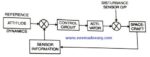
To exercise attitude control, there must be available some measure of a satellite’s orientation in space and of any tendency for this to shift.
In one method, infrared sensors, referred to as horizon detectors, are used to detect the rim of the earth against the background of space.
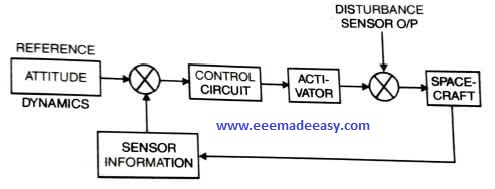
With the use of four such sensors, one for each quadrant, the center of the earth can be readily established as a reference point.
The attitude-control process takes place aboard the satellite, but it is also possible for control signals to be transmitted from earth, based on attitude data obtained from the satellite.
Whenever a shift in attitude is desired, an attitude maneuver is executed. The control signals needed to achieve this maneuver may be transmitted from an earth station.
Controlling torques may be generated in a number of ways. Passive attitude control refers to the use of mechanisms which stabilize the satellite without putting a drain on the satellite’s energy supplies; at most, infrequent use is made of these supplies, for example, when thruster jets are impulsed to provide corrective torque.
xamples of passive attitude control are spin stabilization and gravity gradient stabilization.
The other form of attitude control is active control.
With active attitude control, there is no overall stabilizing torque present to resist the disturbance torques. Instead, corrective torques are applied in response to disturbance torques. Methods used to generate active control torques include momentum wheels, electromagnetic coils, and mass expulsion devices, such as gas jets and ion thrusters.
Read Also:
Books for All Competitive Exams
Telecommunication Objective Questions with answers, UVH,VHF,LED,LCD
Television (TV) Basics|History of Television
Picture and Sound reception in TV
More on TV- Television
- Television (TV) Basics|History of Television
- Picture and Sound transmission in TV – part 1
- Picture transmission in TV -part 2
- Picture and Sound reception in TV
Latest Posts in EEE Made Easy
- Satellite Altitude and Orbit Control( AOCS)
 Satellite Altitude and Orbit Control: In this post, Altitude Control & Orbit Control of Satellite is explained. Satellite Altitude and … Read more
 - Planar TransformerPlanar transformer: The planar transformer, or inductor, is a low profile device that covers a large area, whereas, the conventional … Read more
- Best Books for Transformer Design and Electrical Machine DesignBest Books for Transformer Design and Electrical Machine Design: If you are studying Transformer Design, Electrical Machine Design or Design … Read more
- Transformers FundamentalsTransformers Fundamentals: Transformers are static devices that transfer electrical energy from one circuit toanother by the phenomenon of electromagnetic induction … Read more
- Transformer Tank Types|Classification of Transformer TanksTransformer Tank Types: Depending upon the position of the joint between the upper and lower parts, wehave two types of … Read more
- Static Electrification in transformersStatic Electrification in transformers: Generation of static charges, caused by oil streaming on a solid insulating component, is responsible for … Read more
- Special TransformersSpecial Transformers: There are some special transformers like Rectifier Transformers,Converter Transformers for HVDC,Furnace Transformers and Phase Shifting Transformer. Special Transformers … Read more