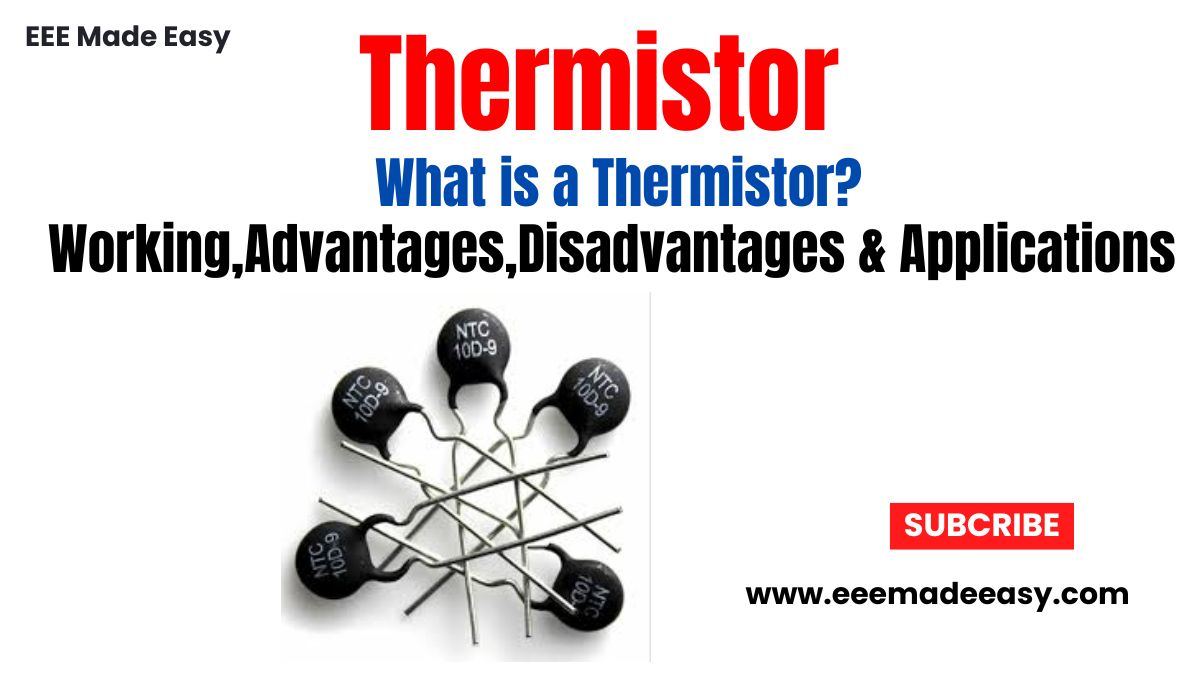
Thermistor: A thermistor, or a thermal resistor, is a two-terminal semiconductor device with temperature-sensitive resistance. The value of such resistors decreases with an increase in temperature.
Materials employed to manufacture the thermistors include oxides of cobalt, nickel, copper, iron, uranium, and manganese.
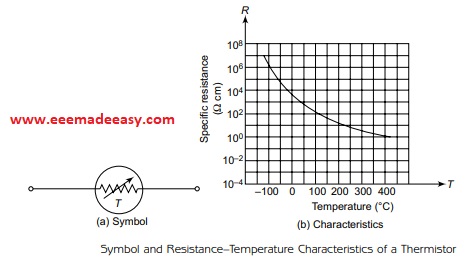
The symbol for a thermistor is shown in the Figure given below.
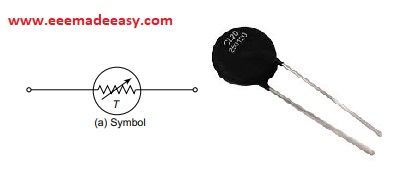
The thermistor has a very high temperature coefficient of resistance, of the order of 3 to 5% per °C,
making it an ideal temperature transducer. The temperature coefficient of resistance is normally negative.
The resistance at any temperature T, is given approximately by
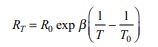
where,RT is the thermistor resistance at temperature T(K), R0 is the thermistor resistance at temperature T0(K) and beta is a constant determined by calibration.
At high temperatures, this equation reduces to

The resistance–temperature characteristic is shown in Figure below. The curve is non-linear and the drop in
resistance from 5000 W to 10 W occurs for an increase in temperature from 20°C to 100°C.
The temperature of the device can be changed internally or externally. An increase in current through the device will raise its temperature, carrying a drop in its terminal resistance.
Any externally applied heat source will result in an increase in its body temperature and drop in resistance. This type of action (internal or external) lends itself well to control mechanisms
Three useful parameters for characterising thermistors are: the time constant, dissipation constant, and the
resistance ratio.
The time constant is the time for a thermistor to change its resistance by 63% of its initial
value, for zero power dissipation.
Typical values of time-constant range from 1–50 s.
The dissipation factor is the power necessary to increase the temperature of a thermistor by 1°C. Typical
values of dissipation factor range from 1 mW/°C to 10 mW/°C.
Resistance ratio is the ratio of the resistance at 25°C to that at 125°C. Its range is approximately 3–60.
Advantages, Disadvantages and Applications of Thermistors
We have listed the advantages, Disadvantages and Applications of Thermistors below.
Advantages of Thermistors
- Compact, low cost and longer life-time.
- Has good stability of the system.
- Has faster response i.e., from seconds to minutes.
- More sensitive when compared to other temperature sensors.
- Compatible with many devices.
- Easy to interface with the external circuits.
Disadvantages of Thermistors
- Requires shielding.
- Requires an input power to activate.
- Low excitation current is required to avoid self-heating.
- Not suitable for large temperature range.
- Non-linear resistance temperature characteristics.
Applications of Thermistors
The applications of thermistor are:
- Measurement of temperature.
- Control of temperature.
- Temperature compensation.
- Measuring voltage and power at high frequencies, thermal conductivity, level, flow and pressure of
liquids and composition of gases. - Used in measuring vacuum and to provide time-delay
Price of Thermistor
You can check HERE
FAQs onThermistor
What is a thermistor and its uses?
Thermistor is device that change the value of its resistance based on increase or decrease of temperature
What are NTC and PTC thermistors?
NTC thermistors are Negative Temperature Coefficient Thermistors and PTC thermistors are Positive Temperature Coefficient Thermistors
Download EEE Made Easy Ebook PDF Free
Join EEE Made Easy Whatsapp Channel
Latest Posts in EEE Made Easy
- 25 MCQs on 8051 Microcontroller- Set 225 MCQs on 8051 Microcontroller: In this post you can practice questions on 8051 Microcontroller. You can … Read more
- 25 MCQs on 8051 Microcontroller25 MCQs on 8051 Microcontroller: In this post you can practice questions on 8051 Microcontroller. You can … Read more
- Transformer MCQs – Set 3Transformer MCQs – Set 3: Here is another Transformer MCQs – Set 3. Set 1 & 2 … Read more
- 25 Transformer MCQs – Set 2Transformer MCQs – Set 2: Here is a new set of 25 questions, this set includes transformer … Read more
- 25 MCQs on Transformers25 MCQs on Transformers: set of 25 Transformer MCQs covering fundamentals, construction, EMF equation, losses, efficiency, voltage … Read more
- Basics of Transformer Ratings and KVA ratingBasics of Transformer Ratings and KVA rating: KVA Rating and Impedance Rating are two common transformer ratings. … Read more
- Satellite Altitude and Orbit Control( AOCS)
 Satellite Altitude and Orbit Control: In this post, Altitude Control & Orbit Control of Satellite is explained. … Read more