Moving Iron Instruments
Moving Iron instruments are mainly used for the measurement of alternating currents and voltages, though it can also be used for d.c measurements.
Working principle of Moving Iron Instruments
The general principle of an M.I instrument can be explained under;
Let a plate or vane of soft iron or of high permeability steel forms the moving element of the system.
The iron vane is situated so as, it can move in a magnetic field produced by a stationary coil. The coil is excited by the current or voltage under measurement.
When the coil is excited, it becomes an electromagnet and the iron vane moves in such a way so as to increase the flux of the electromagnet.
Magnetism-Methods of Magnetization
Thus, the vane tries to occupy a position of minimum reluctance. Thus, the force produced is always in such a direction so as to increase the inductance of the coil.
Types of Moving Iron instrument
There are two types of Moving- iron instruments. Attraction type MI instruments & Repulsion type MI Instruments
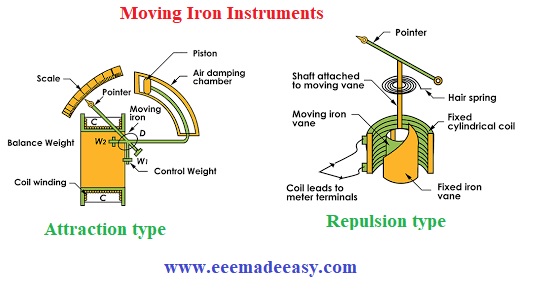
i. Attraction type
In this type of instrument, a single soft iron vane (moving iron) is mounted on the spindle and is attracted towards the coil when operating current flows through it.
Deflecting torque equation
The force F, pulling the soft -iron piece towards the coil is directly proportional to;
a) Field strength H, produced by the coil.
b)pole strength ‘m’ developed in the iron piece.
F α mH
Since, m α H,
F α H2
Instantaneous deflecting torque α H2
Also, the field strength H = μi
If the permeability(μ) of the iron is assumed constant,
Then, H α i
Where, i =instantaneous coil current, Ampere
Instantaneous deflecting torque α i2
Average deflecting torque, Td α mean of i2 over a cycle.
Since the instrument is spring controlled,
Tc α θ
In the steady position of deflection, Td = Tc
θ α mean of i2 over a cycle
α I2
Since the deflection is proportional to the square of coil current, the scale of such instruments is non-uniform (being crowded in the beginning and spread out near the finishing end of the scale).
ii.Repulsion type
In this two soft iron vanes are used; one fixed and attached the stationary coil, while the other is movable (moving iron), and mounted on the spindle of the instrument.
When operating current flows through the coil, the two vanes are magnetized, developing similar polarity at the same ends.
Consequently, repulsion takes place between the vanes and the movable vane causing the pointer to move over the scale.
Two types
i.radial vane type: – vanes are radial strips of iron.
ii.co-axial vane type:-vanes are sections of coaxial cylinders.
Deflecting torque
The deflecting torque results due to repulsion between the similarly charged soft- iron pieces or vanes. If the two pieces develop pole strength of m1 and m2 respectively, then;
Instantaneous deflecting torque α m1m2 α H2
If the permeability of iron is assumed constant, then; H α i, where, i is the coil current
Instantaneous deflecting torque α i2
Average deflecting torque, Td α mean of i2 over a cycle.
Since the instrument is spring controlled, Tcα θ
In the steady position of deflection, Td= Tc
θ α mean of i2 over a cycle.
α I2
Thus, the deflection is proportional to the square of the coil current. The scale of the instrument is non- uniform; being crowded in the beginning and spread out near the finish end of the scale. However, the non- linearity of the scale can be corrected to some extent by the accurate shaping and positioning of the iron vanes in relation to the operating coil.
Reference Books
(i)A.K Sawhney, Electrical and Electronic Instrumentation and Measurements,
(ii)V.K Mehta, Rohit Mehta,Basic Electrical Engineering
You can buy the text books from below links
- [PDF]Electrical Measurements Measuring Instruments Study Notes PDF|EMMI Notes EEE Made Easy
- MCQ on Electrical Instruments
- Types of Errors in Instruments| Instrument Errors
- MCQ’s on Electrical Measuring Instruments|Instruments Objective Questions
- Electrical measuring instruments|Types of Measuring Instruments
- Static characteristics of instruments
- Types of measuring instruments- www.eeemadeeasy.com
- Moving Iron Instruments
- Instruments- Basics
- PMMC Instruments
- Types of instruments
- Essentials of Indicating instruments
- MCQ’s on Galvanometer|Galavnometer Questions & Answers
- MCQs on potentiometer|potentiometer Questions and answers
- TOD Meter or Time of Day Meter
- Light meters or illumination meter|Lux meter
- VU and decibel meters
- Multimeter- Principle and operation
- Digital readout meters-principle and operation
- Watt-hour meters- principle and operation
- Wattmeter -principle and working
- FET and vacuum-tube voltmeters
- Ohmmeter- basic principle and working
- Ammeters|Current Measurement
- Voltmeter- Principle and operation
- The household energy meter is
- Q Meter
- Thermistor| What is a Thermistor
- RTD vs Thermistor|Comparison between RTD and Thermistor
Latest Posts in EEE Made Easy
- 25 MCQs on 8051 Microcontroller- Set 225 MCQs on 8051 Microcontroller: In this post you can practice questions on 8051 Microcontroller. You can … Read more
- 25 MCQs on 8051 Microcontroller25 MCQs on 8051 Microcontroller: In this post you can practice questions on 8051 Microcontroller. You can … Read more
- Transformer MCQs – Set 3Transformer MCQs – Set 3: Here is another Transformer MCQs – Set 3. Set 1 & 2 … Read more
- 25 Transformer MCQs – Set 2Transformer MCQs – Set 2: Here is a new set of 25 questions, this set includes transformer … Read more
- 25 MCQs on Transformers25 MCQs on Transformers: set of 25 Transformer MCQs covering fundamentals, construction, EMF equation, losses, efficiency, voltage … Read more
- Basics of Transformer Ratings and KVA ratingBasics of Transformer Ratings and KVA rating: KVA Rating and Impedance Rating are two common transformer ratings. … Read more
- Satellite Altitude and Orbit Control( AOCS)
 Satellite Altitude and Orbit Control: In this post, Altitude Control & Orbit Control of Satellite is explained. … Read more
Latest Posts in EEE Made Easy
- 25 MCQs on 8051 Microcontroller- Set 225 MCQs on 8051 Microcontroller: In this post you can practice questions on 8051 Microcontroller. You can … Read more
- 25 MCQs on 8051 Microcontroller25 MCQs on 8051 Microcontroller: In this post you can practice questions on 8051 Microcontroller. You can … Read more
- Transformer MCQs – Set 3Transformer MCQs – Set 3: Here is another Transformer MCQs – Set 3. Set 1 & 2 … Read more
- 25 Transformer MCQs – Set 2Transformer MCQs – Set 2: Here is a new set of 25 questions, this set includes transformer … Read more
- 25 MCQs on Transformers25 MCQs on Transformers: set of 25 Transformer MCQs covering fundamentals, construction, EMF equation, losses, efficiency, voltage … Read more
- Basics of Transformer Ratings and KVA ratingBasics of Transformer Ratings and KVA rating: KVA Rating and Impedance Rating are two common transformer ratings. … Read more
- Satellite Altitude and Orbit Control( AOCS)Satellite Altitude and Orbit Control: In this post, Altitude Control & Orbit Control of Satellite is explained. … Read more