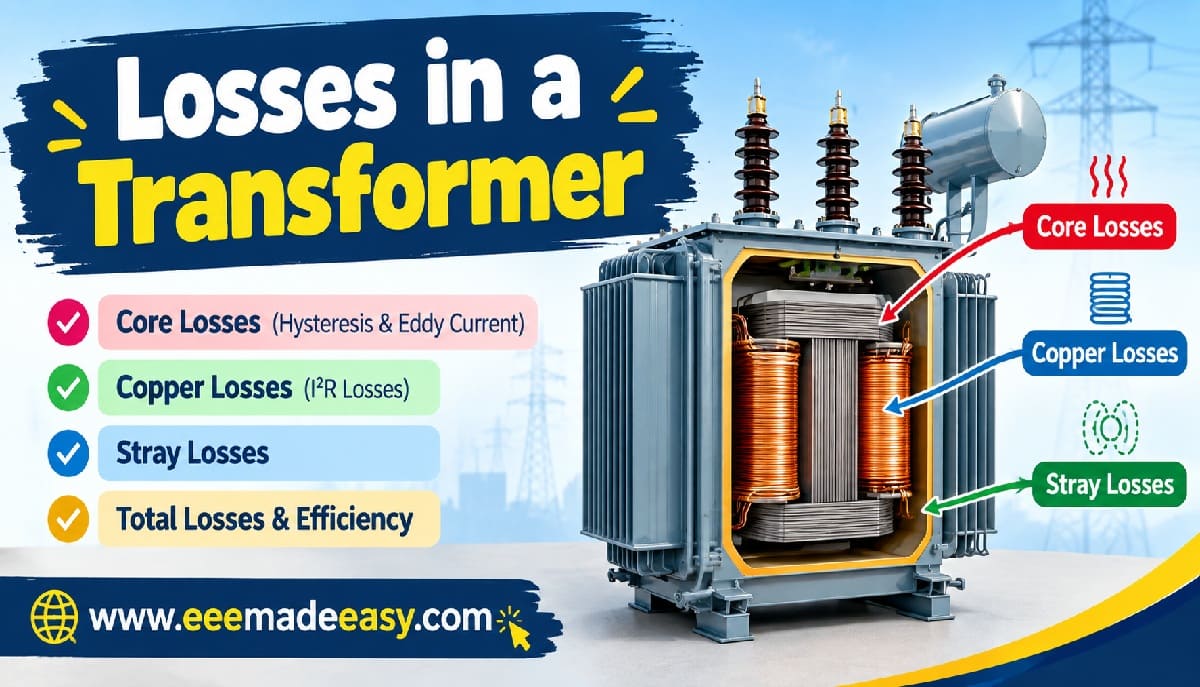
Losses in a Transformer:The losses which occur in an actual transformer are: (i) Core or iron losses (ii) Copper losses
Transformer Losses
(i) Core or iron losses
(b) Eddy current loss
(i) Core or iron losses:
When AC supply is given to the primary winding of a transformer an
alternating flux is set up in the core, therefore, hysteresis and eddy current losses occur in the
magnetic core.
(a) Hysteresis loss
When the magnetic material is subjected to reversal of magnetic flux, it
causes a continuous reversal of molecular magnets. This effect consumes some electric
power which is further dissipated in the form of heat as loss. This loss is known as hysteresis
loss.
Ph = Kh V f Bm2.6
This loss can be minimised by using silicon steel material for the
construction of core.
(b) Eddy current loss
Since flux in the core of a transformer is alternating, it links with the
magnetic material of the core itself also. This induces an emf in the core and circulates
eddy currents. Power is required to maintain these eddy currents. This power is dissipated
in the form of heat and is known as eddy current loss
Pe = Ke V f2 t 2 Bm2
This loss can be minimised by making the core of thin laminations.
It is already seen in article–8 that the flux set up in the core of the transformer remains constant
from no-load to full load. Hence, iron loss is independent of the load and is known as constant
losses.
(ii) Copper losses
Copper losses occur in both the primary and secondary windings due to their
ohmic resistance. If I 1 , I2 are the primary and secondary currents and R1 , R2 are the primary
and secondary resistances, respectively.
Then, total copper losses = I1R12 + I2R22 = I1Rep2 = I2Res2
The currents in the primary and secondary winding vary according to the load, therefore, these
losses vary according to the load and are known as variable loss.
Effects of Voltage and Frequency Variations on Iron Losses
Power transformers are not ordinarily subjected to frequency variations and usually are subject to
only modest voltage variations
Variation of Voltage and Frequency on Transformer Iron Losses
Variation in voltage and/or frequency affects the iron losses (hysteresis and eddy current loss) in a transformer.
As long as the flux variations are sinusoidal, hysteresis loss and eddy current loss vary according to the following relations:
The value 2.6 is an arbitrary value which lies between 1.5 and 2.5, depending on the grade of iron used in the transformer core.
And,
If the transformer is operated with the frequency and voltage changing in the same proportion, the flux density will remain unchanged, as is obvious from the equation:
Therefore,
or,
and apparently, the no-load current will also remain unaffected.
Join EEE Made Easy Whatsapp Channel
Read More on Transformer
- Transformers MCQ questions set 1
- Transformers MCQ Questions- Set 2
- Transformer MCQ Questions Set 3
- Efficiency of Transformer|Equation & Example
- Losses in a Transformer
- [Solved]Transformer Voltage Regulation Problem
- LVDT|Linear Variable Differential Transformer
- Autotransformer|Application of Autotransformer
- Transformers Electrical Engineering Interview Questions
- Why Transformers Hum: 7 Shocking Causes and Expert Solutions You Need to Know
- Single-phase transformer Connections Series & parallel
- Hysterisis and Eddy current losses