Conductor Materials for conducting electric current
The conductor materials used for transmission and distribution of electrical energy must have the following characteristics.
Characteristics of good conductor materials are;
- It should have a low cost.
- It should be light in weight
- It should have high conductívity.
- It should not be brittle
- It should have a high tensile strength to withstand mechanical stresses.
- Low specific gravity in order to give low weight for unit volume.
- If you want to know about Magnetic materials, read HERE
Aluminum, Copper, and galvanized steel conductors are generally used for the transmission and distribution of electrical energy.
The conductor materials are,
(1) Copper
The resistivity of annealed high conductivity copper is 0.01724 W-m/mm2 at 20°C.
The electrical resistance of copper varies with temperature.
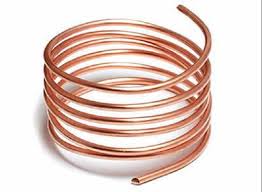
High conductivity copper is available in the form of fully annealed or the hard drawn state depending on the properties required for the items under manufacture.
Hard drawn copper is having double, the tensile strength of annealed copper.
Insulated cables consist of annealed copper whereas overhead lines consist of hard drawn copper.
The busbars for heavy current conductors of relatively short
length is made o1 hard drawn copper.
(2). Aluminium.
Aluminum is replacing copper in many of its applications.
It has a conductivity of 62% that of copper.
In high voltage transmission line aluminum is used as supports, conductors and conductor accessories.
Aluminum is also used as the conductor for distribution cable.
(3) Aluminium Conductor Steel Reinforced (A.C.S.R).
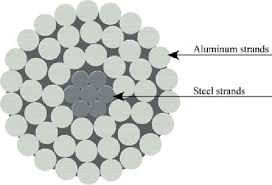
These conductors are used for long-distance high voltage overhead transmission lines.
A.C.S.R. consists of a core of galvanized steel strand surrounded by a number of aluminum strands.
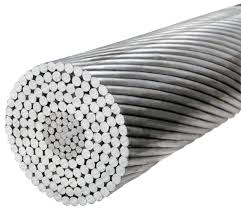
The core is galvanized steel to prevent rusting and electrolytic corrosion. The steel core takes a greater percentage of mechanical stresses and the aluminium carries the current. A.C.S.R. conductors have high tensile strength.
(4) Cadmium copper alloys.
Cadmium copper alloy contain 0.6 to 1% cadmium when cadmium copper is hard drawn.
Its tensile strength is 50% greater than that of hard drawn copper.
It is used for overhead lines and for contact wires for overhead lines.
Advantages of Stranding the Conductors
Stranding of conductors
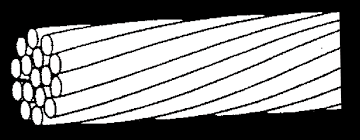
(1) They are more flexible and durable, therefore, can be handled conveniently.
(2) The surface area of stranded conductor is more as compared to the surface area of an equivalent single solid conductor.
As the heat radiating capacity is proportional to the surface area, therefore, a stranded conductor has more heat radiating capacity as compared to a single solid conductor.
Also Read;
Basic Electrical Engineering Expected Questions
Basic Electrical Engineering MCQ
CELLS and Batteries notes
- 25 MCQs on 8051 Microcontroller- Set 225 MCQs on 8051 Microcontroller: In this post you can practice questions on 8051 Microcontroller. You can detailed notes … Read more
- 25 MCQs on 8051 Microcontroller25 MCQs on 8051 Microcontroller: In this post you can practice questions on 8051 Microcontroller. You can detailed notes … Read more
- Transformer MCQs – Set 3Transformer MCQs – Set 3: Here is another Transformer MCQs – Set 3. Set 1 & 2 can be … Read more
- 25 Transformer MCQs – Set 2Transformer MCQs – Set 2: Here is a new set of 25 questions, this set includes transformer construction, turns … Read more
- 25 MCQs on Transformers25 MCQs on Transformers: set of 25 Transformer MCQs covering fundamentals, construction, EMF equation, losses, efficiency, voltage regulation, tests, … Read more