Compensating Windings: Compensating Windings are used for large direct current machines which are subjected to large fluctuations in load i.e. rolling mill motors and turbo-generators etc. Their function is to neutralize the cross magnetizing effect of armature reaction.
Join EEE Made Easy Whatsapp Channel
Compensating Windings
In the absence of compensating windings, the flux will be suddenly shifting backward and forward with every change in load. This shifting of flux will induce statically induced e.m.f. in the armature coils.
The magnitude of this e.m.f. will depend upon the rapidity of changes in load and the amount of change. It may be so high as to strike an arc between the consecutive commutator segments across the top of the mica sheets separating them.
This may further develop into a flash-over around the whole commutator there by short-circuiting the whole armature.
Join EEE Made Easy Telegram channel
These windings are embedded in slots in the pole shoes and are connected in series with armature in such a way that the current in them flows in opposite direction to that flowing in armature conductors directly below the pole shoes. An elementary scheme of compensating winding is shown in Fig. below.
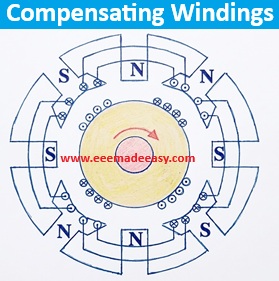
It should be carefully noted that compensat-ing winding must provide sufficient m.m.f so as to counterbalance the armature m.m.f.
Let,
Z_{c} = of compensating conductos/pole face
Z_{a} = No. of active armature conductors/pole.
Total armature current I at =
l at /A= current/armature conductor
Z_{c}*I_{a} = Z_{a}(l / A) or Z_{c} = Z / A
Owing to their cost and the room taken up by them, the compensating windings are used in the case of large machines which are subject to violent fluctuations in load and also for generators which have to deliver their full-load output at consider-able low induced voltage as in the Ward-Leonard set.
Books for All Competitive Exams
Read: Armature Reaction MCQ|DC Generator MCQ Questions|DC machines
Download EEE Made Easy Ebook PDF Free
Read more on DC Machines
- Armature Reaction MCQ|DC Generator MCQ Questions|DC machines
- Compensating Windings
- DC Machines Questions and Answers|DC Machines MCQ
- D.C Machines|What is a DC machine
- Armature Reaction in DC Machines|Cross Magnetization and Demagnetization
- 50 MCQ questions on DC Motor|Electrical Machines MCQ Questions and answers|DC Motor MCQ
- MCQs on DC Motor Tests|Tests on DC Motor Objective Questions
- Speed Control of D.C Motor MCQ Questions|Objective Questions on DC Motor Speed Control
- DC motor objective questions for Industrial extension officer ssc JE Electrical
- Speed Control of DC Motor|Shunt, Series, Compound DC Motor Speed control
- Efficiency of DC Motors with Example