Electric heating is a process in which electrical energy is converted to heat energy. According to Joule’s Law the resistance loss I2 R t is used to producing the heat from electrical energy for various industrial purposes like electric heating, welding etc.
Join EEE Made Easy Whatsapp Channel
Materials Used for Heating Elements
The performance and life of heating element depend on properties of the material used for heating element.
properties in material used for heating elements
The required properties in material used for heating elements are
1. High melting point.
2. Free from oxidation in open atmosphere.
3. High tensile strength.
4. Sufficient ductility to draw the metal or alloy in the form of wire.
5. High resistivity.
6. Low temperature coefficient of resistance.
Following material are used for manufacturing heating element
1. Nichrome
2. Kanthal
3. Cupronickel
4. Platinum
Nichrome
Composition of Nichrome : Ni = 80% + Cr = 20%
Resistivity : 40 µΩ-cm
Temperature coefficient of resistance: 0.0004 /◦C
Melting point : 1400◦C
Specific gravity : 8.4gm /cm3
High resistance to oxidation
Use of Nichrome : Used in making heating elements for electric heaters and furnaces.
Kanthal
Composition of Kanthal : Fe = (62.5-76%) + Cr = (20-30%) + Al = (4-7.5%)
Resistivity at 20◦C: 145 µΩ -cm
Temperature coefficient of resistance at 20◦C: 0.000001/◦C
Melting point: 1500◦C
Specific gravity: 7.10 gm /cm3
High resistance to oxidation
Cupronickel
Composition of Cupronickel : Cu = 66% + Ni = 30% + Fe = 2% + Mn = 2%
Resistivity at 20◦C: 50 µΩ -cm
Temperature coefficient of resistance at 20-500◦C : 0.00006 /◦C
Melting point: 1280◦C
Specific gravity: 8.86gm / cm3
High resistance to oxidation
Platinum
Resistivity at 20oC: 10.50 µΩ -cm
Temperature coefficient of resistance at 20◦C: 0.00393 /◦C
Melting point: 1768.30◦C
Specific gravity: 21.45gm/cm3
High resistance to oxidation
Classification of Electric Heating

1.Power Frequency Heating
Electric Resistance Heating
Electric resistance heating is defined as ”the heat produced by passing an electric current through a
material that has high resistance.” As the current passes through the material, ohmic losses (I2R losses)
occur. These losses cause the conversion of electrical energy in to heat.
There are two methods of electric resistance heating.
a. Direct electric resistance heating
In direct electric resistance heating, the current is passed directly through the material that has to be
heated, for example, resistance welding, electrode boiler, salt bath furnace.
Electrode boiler: Current is passed through the fluid to be heated via electrodes
b. Indirect electric resistance heating
In indirect electric resistance heating, the current is passed through a highly resistive material placed inside an oven, for example room heaters, immersion heaters, resistance ovens, domestic and commercial cooking and heat treatment of metals.

In the indirect resistance heating, the current does not flow through the body to be heated but it flows through the resistance elements which get heated up. The heat is then transferred from the heating element to the charge mainly by radiation or convection.
2.High Frequency Heating
Induction Heating
Induction heating is the process of heating an electrically conducting object (usually a metal) by electromagnetic induction, through heat generated in the object by eddy currents.
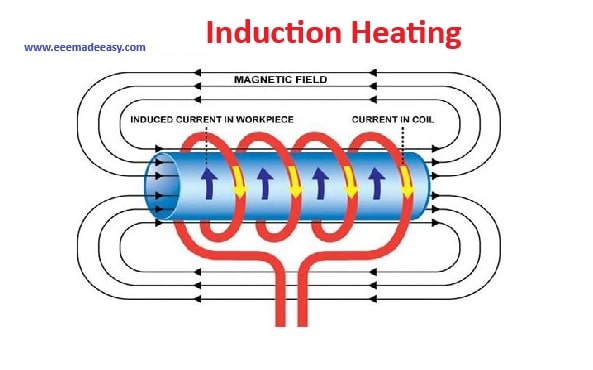
An induction heater consist of an electromagnet and an electronic oscillator that passes a high frequency alternating current (AC) through the electromagnet. The rapidly alternating magnetic field penetrates the object, generating electric current inside the conductor, called eddy currents. The eddy currents flowing through the resistance of the material heat it by joule heating.
An important feature of the induction heating process is that the heat is generated inside the object itself.
Working Principle
Large AC current are sent through the copper coil. The large current in the coil generate strong magnetic fields. These magnetic field lines cause Eddy currents.
Frequency of the magnetic filed lines is tuned based on the object size and material composition. The natural electrical resistance of the metal and strong eddy currents eventually make the metal hot enough to melt.
Application:-
⋆ Heat treatment in metallurgy.
⋆ Zone refining used in the semiconductor industry.
⋆ It is also used in induction cooking.
⋆ Used in plastic moulding machines.
Dielectric Heating (or Electronic Heating or Radio frequency Heating)
Dielectric heating is the process in which a radio frequency alternating field, or radio wave or micro wave electromagnetic radiation heats a dielectric material. At higher frequencies, the heating is caused by molecular dipole rotation with in the dielectric.
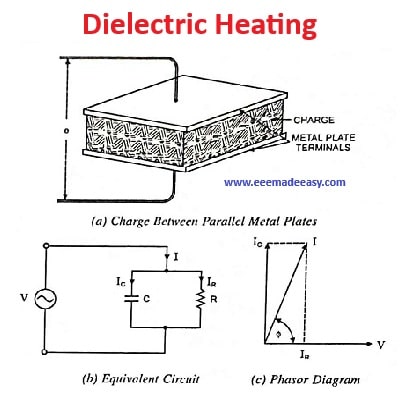
In dielectric heating, it is desirable to use high frequency than high voltage and the heat produced is with in the material itself. Dielectric heating involves the heating of electrically insulating materials by dielectric loss. Frequencies in the range of 10-100 MHz are necessary to cause dielectric heating.
In dielectric heating, the heat generation is uniform, the dielectric material is heated uniformly. This is the important property of dielectric heating.
Applications:-
⋆ Preheating of plastic performs
⋆ Gluing of wood,furniture industry
⋆ In casting and moulding industry
⋆ Diathermy (Dielectric heating of tissues and bones)
⋆ Used for sterilization medical instruments etc.
⋆ Textile industry
⋆ Food processing
Microwave Heating
Above 100 MHz, dielectric heating is categorised as microwave heating. Modern microwave ovens make use of electromagnetic waves with electric fields of much higher frequency and shorter wavelength than RF heaters.
Domestic microwave ovens operate at 2.45 GHz-915 MHz range. This provides for efficient, but less penetrative dielectric heating.
Applications:-
⋆ Pasteurization
⋆ Microwave chemistry
⋆ Sterilization
⋆ Food preservation
⋆ Biofuel production
Join EEE Made Easy Telegram channel
Join EEE Made Easy Whatsapp Channel
- [Set 1]MCQ’s on Electrical Heating|Electrical Heating MCQ Questions and Answers|KSEB Sub Engineer
- [Set 2]MCQ’s on Electrical Heating|Electrical Heating MCQ Questions and Answers|KSEB Sub Engineer
- [Set 3]MCQ’s on Electrical Heating|Electrical Heating MCQ Questions and Answers|KSEB Sub Engineer
Latest Posts in EEE Made Easy
- 25 MCQs on 8051 Microcontroller- Set 225 MCQs on 8051 Microcontroller: In this post you can practice questions on 8051 Microcontroller. You can … Read more
- 25 MCQs on 8051 Microcontroller25 MCQs on 8051 Microcontroller: In this post you can practice questions on 8051 Microcontroller. You can … Read more
- Transformer MCQs – Set 3Transformer MCQs – Set 3: Here is another Transformer MCQs – Set 3. Set 1 & 2 … Read more
- 25 Transformer MCQs – Set 2Transformer MCQs – Set 2: Here is a new set of 25 questions, this set includes transformer … Read more
- 25 MCQs on Transformers25 MCQs on Transformers: set of 25 Transformer MCQs covering fundamentals, construction, EMF equation, losses, efficiency, voltage … Read more
- Basics of Transformer Ratings and KVA ratingBasics of Transformer Ratings and KVA rating: KVA Rating and Impedance Rating are two common transformer ratings. … Read more
- Satellite Altitude and Orbit Control( AOCS)
 Satellite Altitude and Orbit Control: In this post, Altitude Control & Orbit Control of Satellite is explained. … Read more