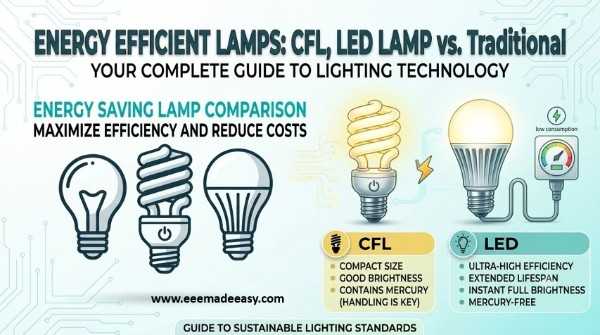
Energy Efficient Lamps: CFL (Compact Fluorescent lamp ) and LED (light emitting diodes) lamp are Energy Efficient Lamps.
Energy Efficient Lamps
Read also: [New]Inspector of Legal Metrology Syllabus|613/2025 Kerala PSC Syllabus
1. Compact Fluorescent lamp (CFL).
A compact fluorescent lamp (CFL), also known as a compact fluorescent light or energy saving light, is a type of fluorescent lamp. Many CFLs are designed to replace an incandescent lamp and can fit into most existing light fixtures formerly used for incandescents.
Compared to general service incandescent lamps giving the same amount of visible light, CFLs use less power and have a longer life. The most important technical advance has been the replacement of electromagnetic ballasts with electronic ballasts. This has removed most of the flickering and slow starting traditionally associated with fluorescent lighting.
There are two main parts in a CFL. The gas filled tube and the electronic ballast. An electrical current from the ballast flows through the gas (mercury vapor), causing it to emit ultraviolet light. The ultraviolet light then excites a phosphor coating on the inside of the tube. This coating emits visible light.
Technical Parts of a CFL Lamp
A CFL (Compact Fluorescent Lamp) works by sending an electrical current through a gas-filled tube, which is a miniaturized version of classic fluorescent tube lighting.
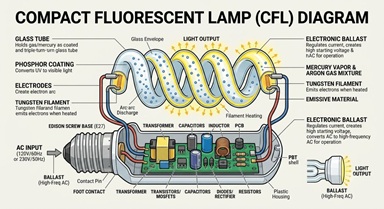
Glass Spiral Tube: A glass tube folded or spiraled to save space. It contains argon gas and a tiny amount of mercury vapor.
Phosphor Coating: The powdery coating on the inside of the glass tube. When the mercury vapor inside is excited by electricity, it emits invisible UV light; this phosphor coating absorbs the UV light and converts it into visible white light.
Electrode: Metal filaments located at the base of the glass tubes. When heated by electrical current, they emit electrons into the tube to trigger the gas discharge.
Electronic Ballast: The circuit board housed in the plastic base. It regulates the current flowing through the lamp and provides the high initial voltage spike needed to start the arc inside the tube.
Screw Base: The threaded metal contact cap that connects the bulb to the main household power socket
CFL Lighting: Advantages
1. Efficient
CFLs are four times more efficient and last up to 10 times longer than incandescents. A 22 watt CFL has about the same light output as a 100W incandescent. CFLs use 50-80% less energy than incandescents.
2. Less Expensive
Although initially more expensive, we can save money in the long run because CFLs use 1/3rd electricity and last upto 10 times as long as incandescents. A single 18 watt CFL used in place of 75W incandescent will save about 570kWh over its life time.
3. Reduces Air and Water Pollution
Replacing a single incandescent bulb with a CFL will keep a half-ton of CO, out 「the atmosphere over the life of the bulb. Saving electricity reduces CO, emission.
4. Versatile
CFLs can be applied nearly anywhere that incandescent lights are used. Dimmable CFLs are also available for lights using a dimmer switch.
LED Lamp
A LED lamp is a solid state lamp that uses light emitting diodes (LEDs) as the source of light. Since the light output of individual light emitting diode is small compared to incandescent and compact fluorescent lamps, multiple diodes are used together.
LED lamps can be made interchangeable with other types. Most LED lamps must also include internal circuits to operate from standard AC voltage. LED lamps offer long life and high efficiency, but initial costs are higher than those of fluorescent lamps.
Technical Parts of an LED Lamp
An LED (Light Emitting Diode) lamp is a highly efficient solid-state lighting source. Here is a breakdown of its key internal and external components:
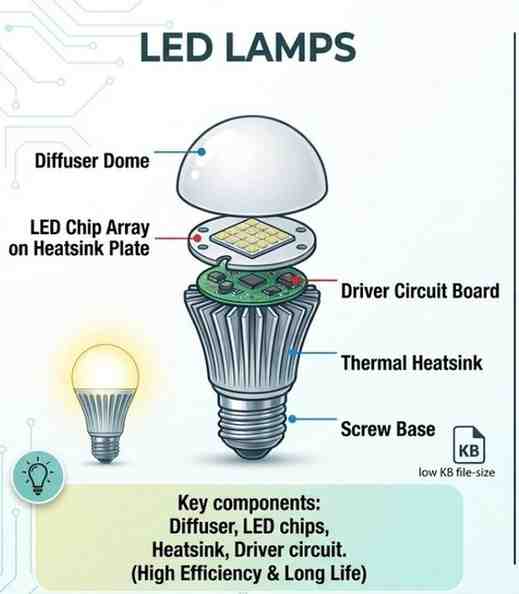
Diffuser Dome: A translucent plastic or glass cover that scatters the intense, directional light from the LED chips to provide even, comfortable illumination without glare.
LED Chip Array (MCPCB): The heart of the bulb. This is a Metal Core Printed Circuit Board populated with multiple tiny light-emitting diodes (SMD chips) that convert electrical energy directly into light.
Thermal Heat Sink: Typically made of aluminum or thermal plastic, this component draws heat away from the sensitive LED chips to keep them cool, ensuring the bulb reaches its long-rated lifespan.
Driver Circuit Board: The “brain” of the lamp. It converts the incoming AC voltage from your home grid into the steady DC current required by the LED chips, while also protecting them from voltage fluctuations.
Screw Base: The metal contact base (commonly an E27 screw or B22 bayonet cap) that physically secures the lamp into the holder and connects it to the electrical supply.
Advantages of LED lighting
1. Long lasting
LED bulbs last upto 10 times as long as compact fluorescents and far longer than typical incandescents.
2. Durable
Since LEDs do not have a filament, they are not damaged under circumstances when a regular incandescent bulb would be broken.
3. Mercury free
No mercury is used in the manufacturing of LEDs.
4. More efficient
LED light bulbs use only 2-10 watts of electricity. LED bulbs last for years, energy is saved in maintenance and replacement costs.
5. Light for remote areas
Because of the low power requirement for LEDs, using solar panels becomes more practical and less expensive than running an electric line or using a generator for lighting.
6. Range of colours
LEDs are available in range of colours including white light.
7. Small size / Design flexibility
A single LED is very small and produces little light overall. However, this weakness is actually its strength. LEDs can be combined in any shape to produce desired lumen packages as the design goals and economics permit.
Join EEE Made Easy Whatsapp Channel
Join EEE Made Easy Telegram channel
LASER MCQs| Industries Extension officer|IEO 2025
125 Electrical Engineering Interview Questions
Books for All Competitive Exams
Latest Posts in EEE Made Easy
- 25 MCQs on 8051 Microcontroller- Set 225 MCQs on 8051 Microcontroller: In this post you can practice questions on 8051 Microcontroller. You can … Read more
- 25 MCQs on 8051 Microcontroller25 MCQs on 8051 Microcontroller: In this post you can practice questions on 8051 Microcontroller. You can … Read more
- Transformer MCQs – Set 3Transformer MCQs – Set 3: Here is another Transformer MCQs – Set 3. Set 1 & 2 … Read more
- 25 Transformer MCQs – Set 2Transformer MCQs – Set 2: Here is a new set of 25 questions, this set includes transformer … Read more
- 25 MCQs on Transformers25 MCQs on Transformers: set of 25 Transformer MCQs covering fundamentals, construction, EMF equation, losses, efficiency, voltage … Read more
- Basics of Transformer Ratings and KVA ratingBasics of Transformer Ratings and KVA rating: KVA Rating and Impedance Rating are two common transformer ratings. … Read more
- Satellite Altitude and Orbit Control( AOCS)
 Satellite Altitude and Orbit Control: In this post, Altitude Control & Orbit Control of Satellite is explained. … Read more