Hysterisis and Eddy current losses: When magnetic materials undergo cyclic variations of flux density, hysteresis and eddy-current power losses occur in them, which are together known as core loss, and appear in the form of heat.
The core loss is important in determining temperature rise, rating and efficiency of transformers, machines and other acoperated electromagnetic devices.
Join EEE Made Easy Whatsapp Channel
Hysteresis Loss
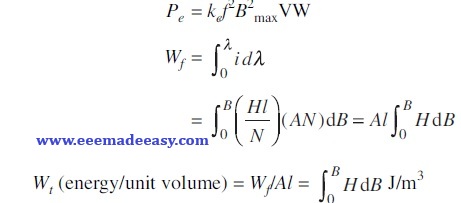
With reference to the hysteresis loop of Fig. 5.21, the energy absorbed by a ferromagnetic material per unit
volume6 as H is raised from zero to Hmax is
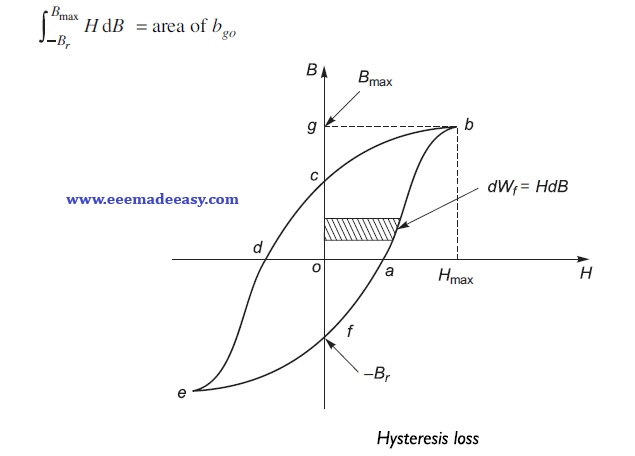
As H is reduced to zero, energy from the magnetic field is returned to the source of excitation as dB is
now negative. Per unit value of energy returned is
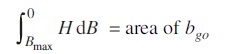
In half cycle of H, variation energy not recovered from the material is the area of bco. In one complete
cycle of variation, energy lost per unit volume is the area of the hysteresis loop.
It is established empirically that for a given volume of material, power loss on account of hysteresis is
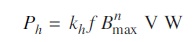
where kh = characteristic constant of core material
n = Steinmetz exponent; range 1.5–2.0; typical value 1.6
V = volume of the material (m3)
Eddy-Current Loss
Since core is made of conducting material, voltages induced in it by alternating flux produce circulating
currents in iron. These are called eddy currents and are accompanied by i2r loss which is called eddy- current loss. As induced voltages and currents are proportional to frequency and flux density (Eq. 5.47), it is
reasonable to expect that the power loss will vary as
Silicon Steel Silicon steel produced by adding 4% silicon to iron has much higher resistivity. The
increased resistance of eddy-current paths reduces the resistive loss which is i2r = v2/r for given induced
voltage.
Laminating Steel To increase the path lengths of eddy currents, the steel is cut into thin laminations
(0.35 mm) along the flux paths. The laminations are lightly insulated from each other by varnish. This restricts
the eddy currents to individual lamination resulting in very much elongated eddy paths and consequent
reduction in eddy-current loss.
Screening Effect The eddy currents produce their own flux in the core, which by Lenz’s law pushes
the main flux away from the core centre, making the flux density at the centre lower than that near the
core surface. This screening effect of eddy currents is negligible at lower frequencies but may be of great
importance at high frequencies as it effectively reduces the core cross section
Join EEE Made Easy Telegram channel
Join EEE Made Easy Whatsapp Channel
Read: Electric Heating:Types, Materials for Heating Elements
Download EEE Made Easy Ebook PDF Free
Books for All Competitive Exams
Latest Posts in EEE Made Easy
- 25 MCQs on 8051 Microcontroller- Set 225 MCQs on 8051 Microcontroller: In this post you can practice questions on 8051 Microcontroller. You can … Read more
- 25 MCQs on 8051 Microcontroller25 MCQs on 8051 Microcontroller: In this post you can practice questions on 8051 Microcontroller. You can … Read more
- Transformer MCQs – Set 3Transformer MCQs – Set 3: Here is another Transformer MCQs – Set 3. Set 1 & 2 … Read more
- 25 Transformer MCQs – Set 2Transformer MCQs – Set 2: Here is a new set of 25 questions, this set includes transformer … Read more
- 25 MCQs on Transformers25 MCQs on Transformers: set of 25 Transformer MCQs covering fundamentals, construction, EMF equation, losses, efficiency, voltage … Read more
- Basics of Transformer Ratings and KVA ratingBasics of Transformer Ratings and KVA rating: KVA Rating and Impedance Rating are two common transformer ratings. … Read more
- Satellite Altitude and Orbit Control( AOCS)
 Satellite Altitude and Orbit Control: In this post, Altitude Control & Orbit Control of Satellite is explained. … Read more