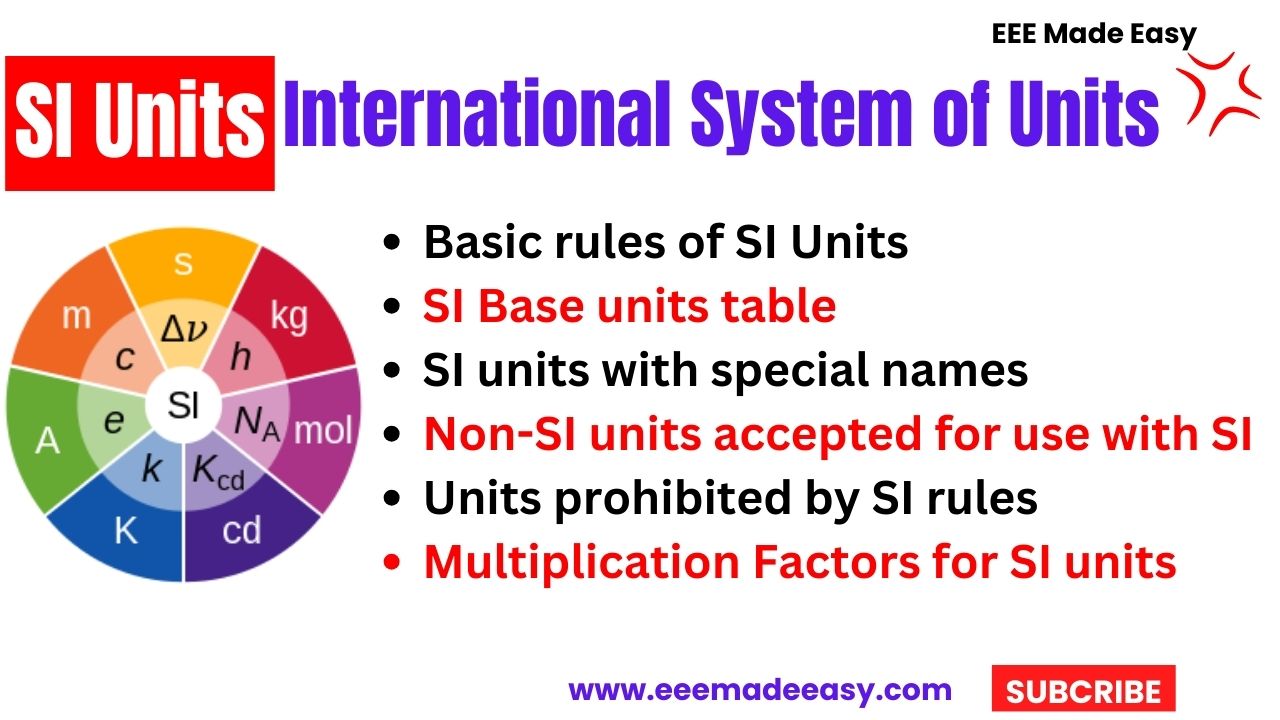
The SI Units or International System of Units is the modern form of the metric system and the world’s most widely used system of measurement, Coordinated by the International Bureau of Weights and Measures.
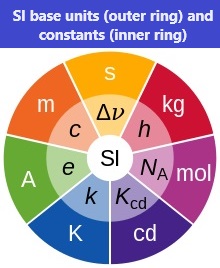
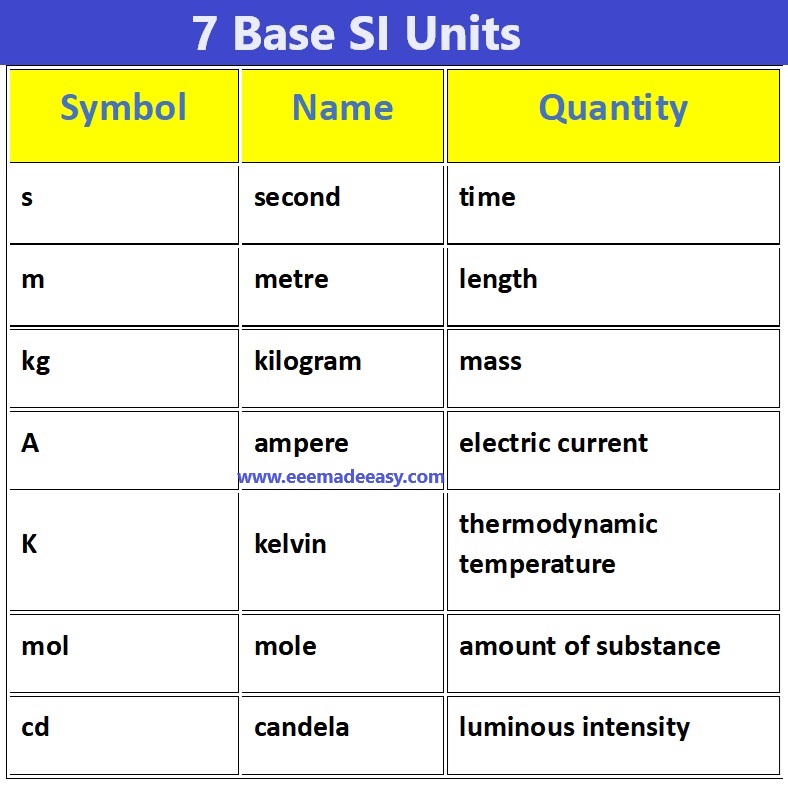
The SI comprises a coherent system of units of measurement starting with seven base units, and are the second (symbol s, the unit of time), metre (m, length), kilogram (kg, mass), ampere (A, electric current), kelvin (K, thermodynamic temperature), mole (mol, amount of substance), and candela (cd, luminous intensity).
Read Another post on SI Units HERE
Basic rules of SI Units
- SI units is not different from the metric system, it is just a selection of certain units.
- Multiples of a SI unit should increase or decrease by a factor of 1000
- Write units in full or denoted by correct symbols
- Except for Celsius, unit names are never capitalized
- Prefixes and all symbols that indicate ≤ 103 are written in lower case except for proper names
- Separate a numerical value and its symbol (e.g., 400 W not 400W)
- When a numerical value is used as an adjective, use a hyphen between the value and its symbols (e.g., a 400-W lamp not a 400 W lamp)
- Symbols are not changed in the plural form
- Unit names follow normal grammatical rules for plural forms;lux, hertz, and siemens are never changed to a plural form
- Use a space between units, e.g., km h-1 not kmh-1
- Division of one unit can be expressed by a solidus or a negative index; only one solidus may be used
- Only the numerator should be changed in multiples of 1000; the denominator must remain as the base value; the one exception is kg
Read Also: Physical Quantities and Units
SI Units table
SI Base units table
| Symbol | Name | Quantity |
|---|---|---|
| s | second | time |
| m | metre | length |
| kg | kilogram | mass |
| A | ampere | electric current |
| K | kelvin | thermodynamic temperature |
| mol | mole | amount of substance |
| cd | candela | luminous intensity |
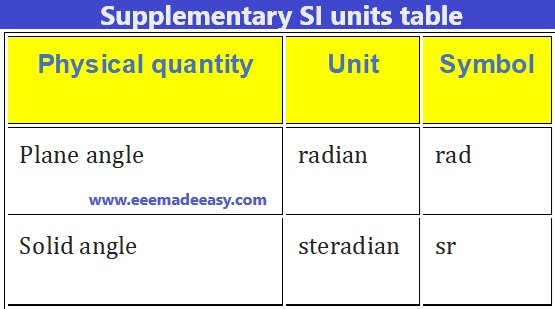
Supplementary SI units table
| Physical quantity | Unit | Symbol |
|---|---|---|
| Plane angle | radian | rad |
| Solid angle | steradian | sr |
Join EEE Made Easy Telegram channel
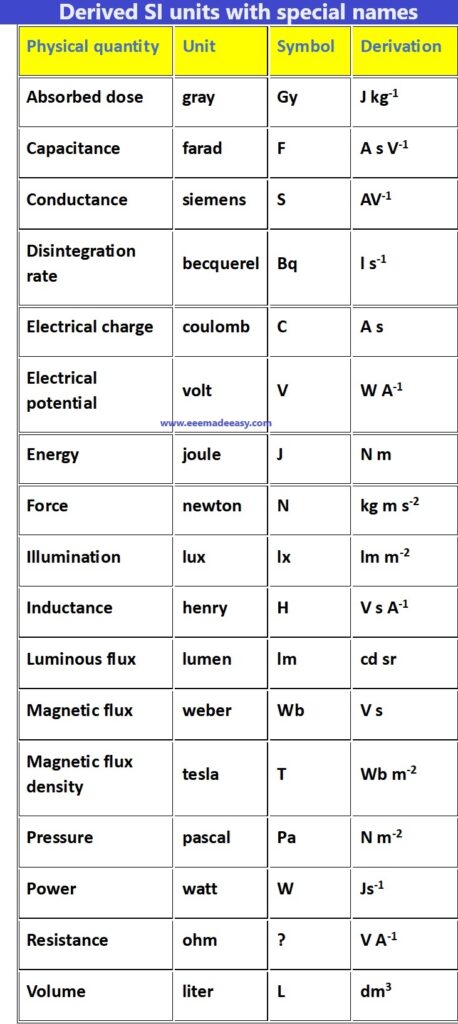
Derived SI units with special names
| Physical quantity | Unit | Symbol | Derivation |
|---|---|---|---|
| Absorbed dose | gray | Gy | J kg-1 |
| Capacitance | farad | F | A s V-1 |
| Conductance | siemens | S | AV-1 |
| Disintegration rate | becquerel | Bq | l s-1 |
| Electrical charge | coulomb | C | A s |
| Electrical potential | volt | V | W A-1 |
| Energy | joule | J | N m |
| Force | newton | N | kg m s-2 |
| Illumination | lux | lx | lm m-2 |
| Inductance | henry | H | V s A-1 |
| Luminous flux | lumen | lm | cd sr |
| Magnetic flux | weber | Wb | V s |
| Magnetic flux density | tesla | T | Wb m-2 |
| Pressure | pascal | Pa | N m-2 |
| Power | watt | W | Js-1 |
| Resistance | ohm | Ω | V A-1 |
| Volume | liter | L | dm3 |
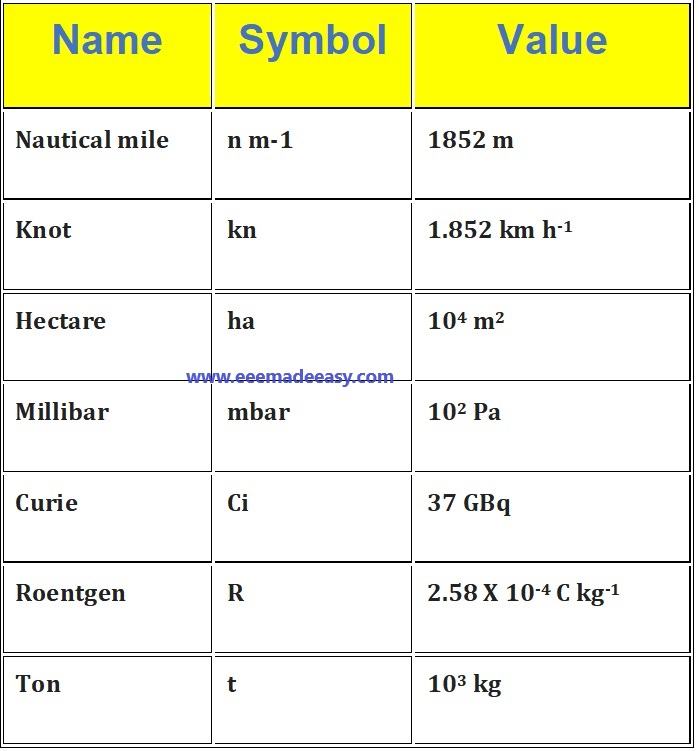
Non-SI units accepted for use with SI
| Name | Symbol | Value |
|---|---|---|
| Nautical mile | n m-1 | 1852 m |
| Knot | kn | 1.852 km h-1 |
| Hectare | ha | 104 m2 |
| Millibar | mbar | 102 Pa |
| Curie | Ci | 37 GBq |
| Roentgen | R | 2.58 X 10⁻⁴ C kg-1 |
| Ton | t | 103 kg |
Download & Install EEE Made Easy App
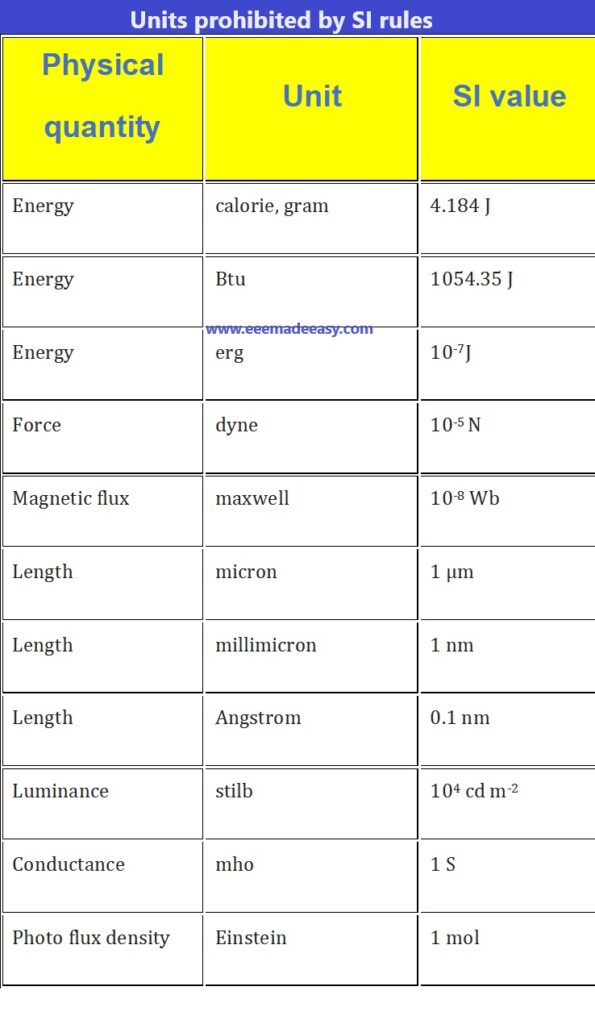
Units prohibited by SI rules
There are some units that are prohibited by SI Rules. Those are given in the Table below.
| Physical quantity | Unit | SI value |
|---|---|---|
| Energy | calorie, gram | 4.184 J |
| Energy | Btu | 1054.35 J |
| Energy | erg | 10-7J |
| Force | dyne | 10-5 N |
| Magnetic flux | maxwell | 10-8 Wb |
| Length | micron | 1 µm |
| Length | millimicron | 1 nm |
| Length | Angstrom | 0.1 nm |
| Luminance | stilb | 104 cd m-2 |
| Conductance | mho | 1 S |
| Photo flux density | Einstein | 1 mol |
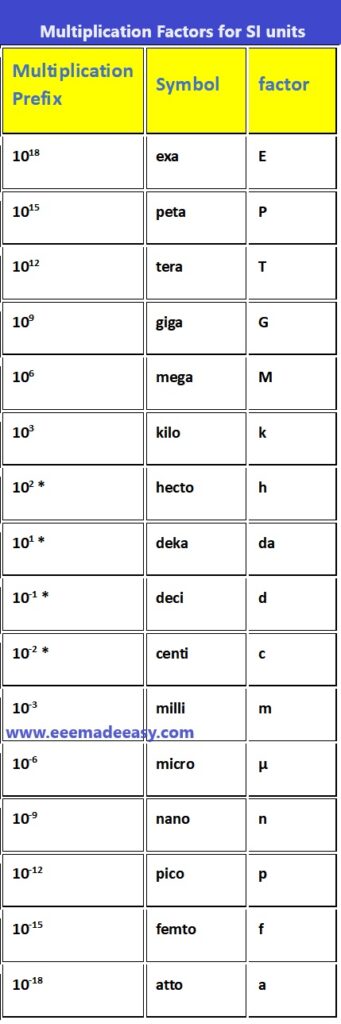
Multiplication Factors for SI units
Note: * Prefixes of 100, 10, 0.1, and 0.01 are not formal SI units
| Multiplication Prefix | Symbol | factor |
|---|---|---|
| 1018 | exa | E |
| 1015 | peta | P |
| 1012 | tera | T |
| 109 | giga | G |
| 106 | mega | M |
| 103 | kilo | k |
| 102 * | hecto | h |
| 101 * | deka | da |
| 10-1 * | deci | d |
| 10-2 * | centi | c |
| 10-3 | milli | m |
| 10-6 | micro | µ |
| 10-9 | nano | n |
| 10-12 | pico | p |
| 10-15 | femto | f |
| 10-18 | atto | a |
Read Also: Physical Quantities and Units
Join EEE Made Easy Whatsapp Channel
SI Units|International System of Units
Latest Posts in EEE Made Easy
- Syllabus Training Instructor Plumber|14/2025 Syllabus Kerala PSCSyllabus Training Instructor Plumber: 14/2025 Syllabus Kerala PSC. Download the syllabus and Previous question papers for the Training Instructor in … Read more
- [PDF] Syllabus AE KSEB Transfer|378/2025 Syllabus Kerala PSCSyllabus AE KSEB Transfer: DETAILED SYLLABUS FOR THE POST OF ASSISTANT ENGINEER(ELECTRICAL) (Kerala State Electricity Board Ltd.) – By Transfer … Read more
- Modified Harvard Architecture
 Modified Harvard Architecture: One of the ways by which the number of clock cycles required for the memory access can … Read more
 - TMS320C5X ArchitectureTMS320C5X Architecture:The TMS320 DSP family consists of two types of single-chip DSPs: 16-bit fixed-point and 32-bit floating-point. These DSPs possess … Read more
- Advantages of Digital Signal ProcessingAdvantages of Digital Signal Processing: Advantages of DSP are Ease of Processing, Thermal Drift and Reliability, Repeatability, Immunity to Noise, … Read more
- [PDF] AE Agro Industries Corporation syllabus|595/2024 syllabus Kerala PSCAE Agro Industries Corporation syllabus: 595/2024 syllabus Kerala PSC: DETAILED SYLLABUS FOR THE POST OF ASSISTANT ENGINEER- THE KERALA AGRO … Read more
- Tellengen’s Theorem & ExampleTellengen’s Theorem: What is Tellengen’s theorem? Tellengen’s Theorem In any arbitrary network, the algebraic sum of the powers in all … Read more