Why Grounding and Earthing Are Not the Same — Learn the top 5 differences between grounding and earthing, explained simply with diagrams for easy understanding.
People often use the terms grounding and earthing interchangeably. While they both involve connecting parts of an electrical system to the ground, they are not the same in concept, function, or purpose. Misunderstanding the difference can lead to incorrect wiring, reduced safety, and potential hazards.
In this guide, we’ll explore why grounding and earthing are not the same, break down the key differences, and support each point with diagrams that make the concepts crystal clear.
Read:Difference between earthing and grounding
Defining Grounding
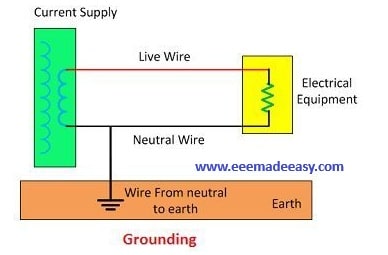
Grounding refers to connecting the non-current-carrying parts of an electrical system—like the body of equipment or metal enclosures—to a common ground point. It is typically done to create a zero-voltage reference point for system operation.
Purpose of Grounding
Provides a return path for fault currents
Maintains voltage stability in the system
Prevents buildup of static electricity
Example: In an electrical panel, the neutral wire is grounded to stabilize voltage and avoid overvoltage conditions.
Read: Wiring and Earthing MCQ- Electrical Engineering MCQ
Defining Earthing
Earthing means connecting the metal body of an electrical appliance or installation to the Earth. It is done to prevent electrical shock in case of insulation failure or leakage current.

Purpose of Earthing
Protects human life by diverting fault current into the Earth
Keeps the exposed conductive parts safe
Activates protective devices like fuses or MCBs
Example: The third pin in a plug (usually green or yellow) is the earthing connection.
Grounding vs Earthing: Key Conceptual Difference
| Feature | Grounding | Earthing |
|---|---|---|
| Flow of current | Under normal or fault conditions | Only during faults |
| Connection point | Between system and ground | Between equipment and ground |
| Reference point | Zero-voltage system reference | Safety measure for body protection |
The simplest way to remember: Grounding stabilizes the system, while earthing protects the user.
Purpose and Functionality Compared
Grounding is used to ensure that all parts of a system operate at the same voltage potential, reducing the risk of uncontrolled surges or unbalanced loads.
Earthing directs any leakage or fault current away from people and property and safely dissipates it into the Earth.
Join EEE Made Easy Whatsapp Channel
Join EEE Made Easy Telegram channel
Download EEE Made Easy Ebook PDF Free
Latest Posts in EEE Made Easy
- 25 MCQs on 8051 Microcontroller- Set 225 MCQs on 8051 Microcontroller: In this post you can practice questions on 8051 Microcontroller. You can … Read more
- 25 MCQs on 8051 Microcontroller25 MCQs on 8051 Microcontroller: In this post you can practice questions on 8051 Microcontroller. You can … Read more
- Transformer MCQs – Set 3Transformer MCQs – Set 3: Here is another Transformer MCQs – Set 3. Set 1 & 2 … Read more
- 25 Transformer MCQs – Set 2Transformer MCQs – Set 2: Here is a new set of 25 questions, this set includes transformer … Read more
- 25 MCQs on Transformers25 MCQs on Transformers: set of 25 Transformer MCQs covering fundamentals, construction, EMF equation, losses, efficiency, voltage … Read more
- Basics of Transformer Ratings and KVA ratingBasics of Transformer Ratings and KVA rating: KVA Rating and Impedance Rating are two common transformer ratings. … Read more
- Satellite Altitude and Orbit Control( AOCS)
 Satellite Altitude and Orbit Control: In this post, Altitude Control & Orbit Control of Satellite is explained. … Read more