Why Transformers Hum — Magnetostriction is the main reason for transformer noise. .Discover the real reasons behind that buzzing sound and learn 7 proven solutions from experts to silence transformer hums effectively.
Why Transformers Hum: Causes and Solutions
Join EEE Made Easy Whatsapp Channel
Transformers are essential components in modern electrical systems, quietly doing their job of voltage conversion. However, one persistent question often arises: Why do transformers hum? The humming sound isn’t just a mystery—it’s rooted in physics and design. While often harmless, this sound can sometimes indicate underlying issues that require attention.
Understanding the source of this hum helps us appreciate transformer design and, when necessary, take action to reduce or eliminate it. Whether you’re a curious homeowner, an engineer, or a technician, this guide will walk you through why transformers hum and offer actionable solutions to address the issue.
Read : Transformers MCQ questions set 1
Understanding the Basics of Transformer Operation
Transformers work by transferring electrical energy between circuits through electromagnetic induction. A typical transformer consists of a magnetic core, made of laminated steel sheets, and coils of wire known as windings.
When alternating current (AC) flows through the primary winding, it creates a varying magnetic field. This magnetic field induces a current in the secondary winding, changing voltage levels as needed. While the design is elegant, it’s this very operation—especially the changing magnetic field—that leads to audible vibrations.

Primary Cause: Magnetostriction
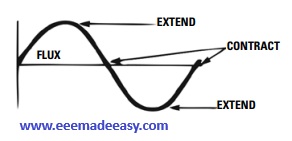
The main reason behind the hum in transformers is magnetostriction. This phenomenon causes the iron core to physically expand and contract slightly when magnetized. Though the change in dimension is microscopic, it happens twice with every AC cycle, creating a consistent 50 or 60 Hz vibration—exactly the frequency we hear as a hum.
What is Magnetostriction?
Any magnetic material contains magnetic dipole and each dipole produces some flux At no magnetic field is applied, the magnetic dipoles are irregularly distributed, and their corresponding fluxes are nullified When the magnetic field is applied, during magnetization all the dipoles align themselves as a string, these agnetic dipoles produce flux in the forward direction Due to this alignment of dipoles, there is a slight change in physical dimension which is called magnetostriction.
How Magnetostriction Works
When the magnetic field fluctuates, it alters the alignment of magnetic domains in the core material. These small movements of the core laminations generate mechanical vibrations, which are transferred to the air as sound waves.
Why the Hum is Constant
Since AC current alternates at fixed frequencies (like 50 or 60 Hz), the resulting magnetostriction occurs rhythmically. That’s why transformer hums have such a consistent tone and pitch.
Core Vibration and Resonance
In addition to magnetostriction, core vibration caused by magnetic flux variations also contributes to the noise. These vibrations become significant when they hit the resonant frequency of the core or surrounding structure, amplifying the hum even more.
Resonance Effects
Resonance can make a relatively small vibration seem much louder. It’s similar to how a guitar string sounds louder when the body of the guitar resonates with the vibration. Likewise, parts of the transformer or its mounting surface can amplify sound unintentionally.
Load-Induced Noise
Transformers don’t always hum at the same volume. Changes in the electrical load they carry can make the hum more or less noticeable.
Low Load: Minimal noise, often barely noticeable.
High Load: Increased magnetic flux results in more magnetostriction and louder humming.
Fluctuating Load: Variable sound intensity that may rise and fall with demand.
Mechanical Causes of Transformer Hum
While magnetostriction is a physical property of the core material, mechanical issues can exacerbate the sound.
Loose Laminations
If the laminated sheets in the core aren’t tightly clamped, they can rattle during magnetostriction-induced movement.
Vibrating Mounts and Casings
Bolts, frames, and enclosures can vibrate if not properly secured. This can create secondary noise that amplifies the hum or adds new tones to it.
External Environmental Factors
Sometimes, the transformer itself isn’t the problem—the environment is. Walls, floors, and installation surfaces can reflect or transmit sound.
Hard surfaces reflect sound waves, amplifying the hum.
Structural coupling can transmit vibration through walls and ceilings.
Poor ventilation can trap sound waves, making them resonate longer.
Questions on Transformer Humming Noise
The humming noise in a large size transformer is caused by
A: the vibration in the lamination of the core due to alternating magnetic flux
B: the step up / step down waveform of the voltage
C: the variation of currents in the alternating cycles in the primary and secondary
D: the boiling of coolant oil
Answer
A : the vibration in the lamination of the core due to alternating magnetic flux
REDUCING TRANSFORMER NOISE AT THE SOURCE
Its not Easy.
Transformer voltages are fixed by system requirements, and the amount of magnetization, by the ratio of these voltages to the number of turns in the winding. The decision on what this ratio of voltage to turns will be, is made for reasons, mainly economic.
It means that the amount of flux at the normal voltage is invariably fixed, thus setting the noise and vibration level. Also, increasing (or decreasing) magnetization does not increase or decrease the magnetostriction by the same amount. In technical terms the relationship is not linear. Therefore, when we are asked, as we invariably are,– “can you reduce the noise level at the source?” – the answer is that it can be done, at a cost and for not much improvement in noise level.
Important poits on Transformer Humming/ Noise
1. Transformer noise is difficult to change at the source. Flux density reduction is the main
thrust, but this means increased cost.
2. Transformer core constructions help to a degree. Reputable manufacturers will use good joints, flat steel, consistent thickness, good core supports, few bolts, etc.
3 Transformer current loading has little or no effect on the noise level.
4. Placing transformers in liquid (oil) does not help since oils are incompressible.
5. Vibration – isolating core and coils within a tank does assist vibration isolation although
isolation of the whole tank is still needed.
6. Noise reduction by distance is the simplest form of attenuation. If it can be achieved without cost–
excellent. Usually it cannot.
7. Noise reduction by screens, bushes, etc., is the next simplest but use should be made of the
topography of the site. Remember the shadow effect means the noise could be heard outside the shadow
of that screen.
8. Full enclosure is usually the only option left to a troublesome transformer.
9. Full enclosure can be made of any material with a high mass/ weight ratio. Brick, concrete, steel have been used. Expect 25- 30dBA reductions.
10. Full enclosures using masonry products are not easily demountable. Prefabricated concrete block is the best for this application.
11. Steel, mass or limp panel techniques make good demountable enclosures. A 15 – 20dBA reduction is possible with properly designed enclosures.
12. External cooling to the enclosure requires flexible treatments to the connecting pipework.
13. Enclosure mounts should be separate from the transformer base – or at least, isolated somehow.
14. All connections – cables, etc. to enclosed transformers should be flexible.
15. Remember bushings vibrate and losses (acoustic) are experienced through them. Flexible acoustic protection between enclosure and bushings are needed.
16. Bushings used in an enclosure might have to have a longer ground sleeve to accommodate
the enclosure roof distances.
17. Pay close attention to access doors and removable covers on enclosures. Tight fits are essential.
18. Watch the dimensions of rooms in which units are mounted. Damp them if necessary, suitable for transformer frequencies.
19. Damping materials are needed if standing waves or reverberations are possible.
20. Choose damping materials compatible with trans former frequencies.
21. Carry out sound surveys before and after installations. Remember to do a frequency analysis so that transformer noise can be differentiated.
22. Anticipate transformer noise problems when accommodating them inside a building – especially for dry types.
23. Pay careful attention to removing unnecessary bolting or stiffening used originally for shipping. transformers are provided with vibration isolators under the core and coil assembly. These isolators
are made ineffective during shipment by shipping bars and/ or tightened bolt-down hardware.
Upon installation, this shipping hardware and fasteners should be removed or loosened according the installation manual. All other shipping hardware painted red should be removed. See installation manual for details.
24. Remember transformers need cooling air in rooms. Be careful (acoustically) when you position air ducts, ventilators and grilles, etc.
25. Pay attention to flexible connections inside rooms containing transformers.
26. Select rooms which are not near potential complaint areas.
27. Check the voltage on the system. Increased flux density by having a higher than normal system voltage
will raise the noise level. Most transformers are provided with tap connections to accommodate higher voltages if necessary. This will prevent the flux density from being elevated.
See instruction manual for details on how to change these taps and make the connections properly
28. When assessing the required noise level of a transformer work backwards from the required noise
level at a location. Consider the inefficiencies of the site.
29. Consider very carefully where transformers will be mounted. Resilient structures such as wooden mezzanines might be harmful.
Join EEE Made Easy Whatsapp Channel
Read More on Transformer
Download EEE Made Easy Ebook PDF Free
Join EEE Made Easy Telegram channel
- Syllabus Training Instructor Plumber|14/2025 Syllabus Kerala PSC
- [PDF] Syllabus AE KSEB Transfer|378/2025 Syllabus Kerala PSC
- Modified Harvard Architecture

- TMS320C5X Architecture
- Advantages of Digital Signal Processing
- [PDF] AE Agro Industries Corporation syllabus|595/2024 syllabus Kerala PSC
- Tellengen’s Theorem & Example
- TOD Meter or Time of Day Meter
- Substitution Theorem & Examples
- Reciprocity Theorem with Examples
- MCQs Basic Computing|Computer MCQ
- Emerging Technologies In Computing|Computing Technologies