Substitution Theorem: The Substitution Theorem is used in circuit analysis to simplify complex networks by replacing a branch (like a resistor) with an equivalent voltage or current source, provided the voltage across or current through that branch remains identical, thus keeping the rest of the circuit’s behavior (voltages/currents) unchanged.
Join EEE Made Easy Whatsapp Channel
Substitution Theorem
Read Also: Reciprocity Theorem
Defenition
In a linear network, any passive element can be replaced by a voltage source whose magnitude is the drop across that element, and the polarity of the source is the drop polarity across that element, provided the other branch currents and voltages are constant.

Problem 1
For the circuit shown in the following figure, the 1 Ω resistor can be replaced by
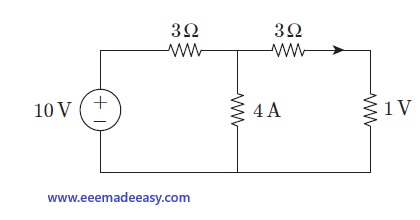
Solution: Using the substitution theorem, the equivalent circuit can be represented as follows.

So 1 Ω resistor can be replaced with voltage source of 1 V with the positive terminal upwards.
Read: Reciprocity Theorem
Join EEE Made Easy Telegram channel
Books for All Competitive Exams
Electrical Circuit Theorems
Latest Posts in EEE Made Easy
- Syllabus Training Instructor Plumber|14/2025 Syllabus Kerala PSCSyllabus Training Instructor Plumber: 14/2025 Syllabus Kerala PSC. Download the syllabus and Previous question papers for the Training Instructor in … Read more
- [PDF] Syllabus AE KSEB Transfer|378/2025 Syllabus Kerala PSCSyllabus AE KSEB Transfer: DETAILED SYLLABUS FOR THE POST OF ASSISTANT ENGINEER(ELECTRICAL) (Kerala State Electricity Board Ltd.) – By Transfer … Read more
- Modified Harvard Architecture
 Modified Harvard Architecture: One of the ways by which the number of clock cycles required for the memory access can … Read more
 - TMS320C5X ArchitectureTMS320C5X Architecture:The TMS320 DSP family consists of two types of single-chip DSPs: 16-bit fixed-point and 32-bit floating-point. These DSPs possess … Read more
- Advantages of Digital Signal ProcessingAdvantages of Digital Signal Processing: Advantages of DSP are Ease of Processing, Thermal Drift and Reliability, Repeatability, Immunity to Noise, … Read more
- [PDF] AE Agro Industries Corporation syllabus|595/2024 syllabus Kerala PSCAE Agro Industries Corporation syllabus: 595/2024 syllabus Kerala PSC: DETAILED SYLLABUS FOR THE POST OF ASSISTANT ENGINEER- THE KERALA AGRO … Read more
- Tellengen’s Theorem & ExampleTellengen’s Theorem: What is Tellengen’s theorem? Tellengen’s Theorem In any arbitrary network, the algebraic sum of the powers in all … Read more